
Designed & maintained by Carol Gingell

© C.Gingell 2006-
© Broadland Memories 2006-


 1950s History
1950s Memories
1950s History
1950s Memories
1950s Photo Gallery


A small set of photographs from the Pleasants Family. Geoffrey Pleasants was the landlord of the Kings Head Hotel at Wroxham between 1948 and 1956. From there he moved to the Maltsers where he was the proprietor until 1962. He also took on the lease of the original Wayford Bridge Arms in 1957, purchasing from the Steward & Patteson brewery when it was de-
The back bar of the Kings Head Hotel at Hoveton/Wroxham c1950.
Whilst he was landlord of the Kings Head, Geoffrey Pleasants hired out motor launches and rowing boats. This photograph shows some of those, undercover in the boathouse at the hotel. Doug Pleasants identified A549 “Harlequin” and A550 “Columbine” which were apparently built for him by Jack Powles.
A549 “Harlequin” pictured at the Kings Head Hotel in Hoveton with the boatshed seen in the background.
Another photograph of A549 “Harlequin” at the Kings Head. The day boats moved to the Maltsters at Ranworth with the Pleasants family, and later to Wayford Bridge.
One of the Broads Tours passenger launches pictured at Wroxham c1957.


The ladies are seen alongside one of the “Dancing Light” class of cruisers from Herbert Woods boatyard. These 4 berth cruisers were 32 feet in length and were described in Blake’s 1949 brochure as being “Attractive, double cabin craft with excellent internal arrangements affording the maximum comfort and convenience. Separate toilet with additional W.C. And wash basin in aft cabin. Sunshine roof and sliding windows give full light and ventilation. Sideboards, ample drawer and locker facilities. Built in Marine Radio available at small charge. Of unrivalled manoeuvrability, the helmsman has a clear view in all directions, with instantaneous command over speed and direction. The collapsible canopy over the central cockpit ensures comfort in all weathers.” The cost of a week’s hire during the peak summer period was £32 10 shillings.






 Top
Next
Prev
Pages 11 on >>
Top
Next
Prev
Pages 11 on >>
The following collection of photos span at least four or five holidays taken on the Broads by a middle aged couple and were purchased as an undated album. It’s difficult to be sure of the exact dates, but the clothing and hairstyles indicate that they may actually start in the late 1940s and run over into the early 1950s. Because of the uncertainty, and because I would prefer to keep the collection together, I decided to include them all in the 1950s gallery. As is often the case, the couple and the family and friends who accompanied them are all unknown.
The first photograph in the album shows the couple who I presume the album belonged to on the right and left, with a friend or family member standing between them.The clothing and hairstyles seen in these earlier images certainly look very 1940s.
There seem to be two different motor cruisers seen in these earlier photographs -
Another photograph taken during the same holiday -
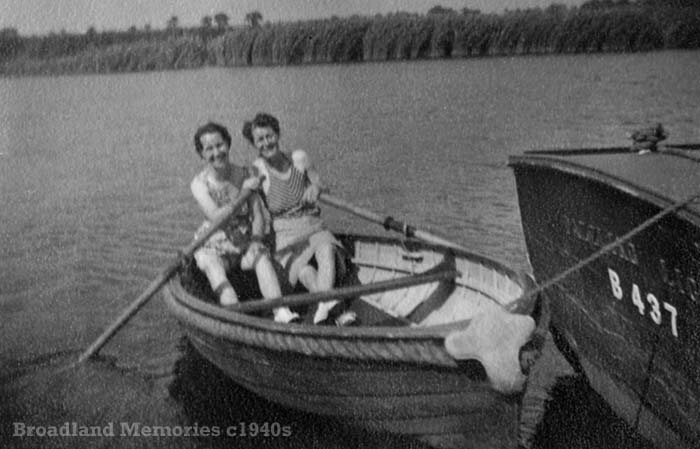
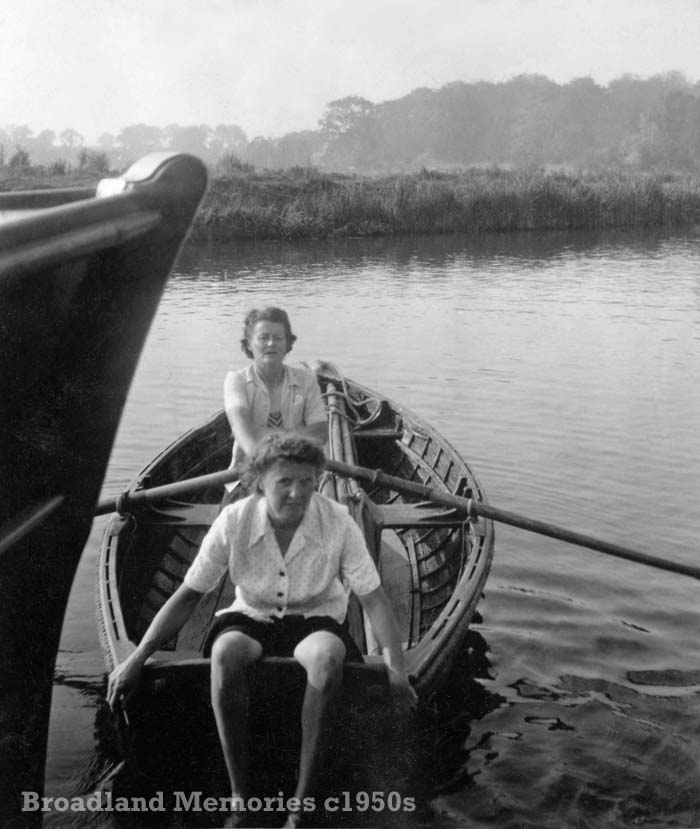
The ladies take to the sailing/rowing dinghy which would have been included within the hire fee.
This is a particularly interesting photograph as it shows Ludham Bridge North Mill which had been converted for use as a pillbox/lookout post during the Second World War alongside the other defences at the bridge.The mill was already derelict at the start of the war, but you can see that the old window openings had been adapted for use as gun ports and a balconied gallery complete with a wooden, cap shaped hut was added to the top. A blast wall was erected beside the entrance to the mill and a spigot mortar gun emplacement was built alongside, the remains of which can still be found today, as can those of a second spigot mortar base on the opposite side of the river. Ludham Bridge itself, along with other Broadland Bridges, was fitted with chambers to hold explosives which could be used to destroy the river crossing should other defences fail. A “Flame Fougasse” was also placed near to the road approaching the bridge, a device which could be remotely detonated and would project burning liquid (petrol) at a target. The field opposite Ludham Bridge boatyard is also rumoured to have been the site of an Alan Williams turret (a rotating, metal pillbox built over a pit).
Another of the earlier photographs in the album.
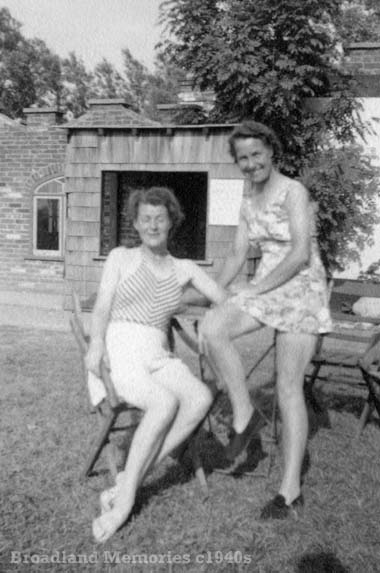
One of two photographs taken at a tearoom at an unknown location on the Norfolk Broads.
The ladies seated at one of the tearoom’s outdoor tables.
Taken during a different holiday on the Broads, the couple are seen her on board B985 “Regal Star” from Jack Powles boatyard at Wroxham.
The holiday party on board “Regal Star”. The four berth cruiser was one of the “Star” class from Jack Powles and had two cabins, each with a toilet and wash basin, plus a spacious saloon with a sunroof over.
Another shot of “Regal Star” with Acle Bridge seen in the background. During the summer of 1952, a week’s hire of one of the Star class cruisers cost £37 10 shillings.
Indulging in a spot of angling on the Norfolk Broads in the early 1950s.
Messing around on the water!
“Regal Star” once again -
Another photograph of “Regal Star” taken at Acle Bridge.
“Regal Star” and crew at Outlon Broad Yacht Station in the early 1950s. The Wherry Hotel can be seen in the background. A 1952 advert for Oulton Broad claimed that it possessed the “finest yacht station on the Broadland Rivers” with “Berthing, stores, supplies, baths, reading and rest rooms available”.
This was also taken at Oulton Broad, in the playground area behind the harbour masters office and ancillary buildings. In his 1953 book “Quays Without Locks”, Harry Griffin described Oulton Broad as a “happy place” where everybody seemed to enjoy themselves but bemoaned the “crescendo of screaming speedboats” and a surfeit of amenities catering for the holidaymakers.
The boating lake at the rear of Nicholas Everitt Park at Oulton Broad -


This was taken in the beer garden of the Bell Inn at St. Olaves, which the 1953 edition of “What To Do..” described as being an old-
Another photograph taken at the Bell Inn which claims to be the oldest pub in Broadland. One 1950s guide to the area mentioned that the original building was erected using stone which had been robbed from the nearby Augustinian priory.
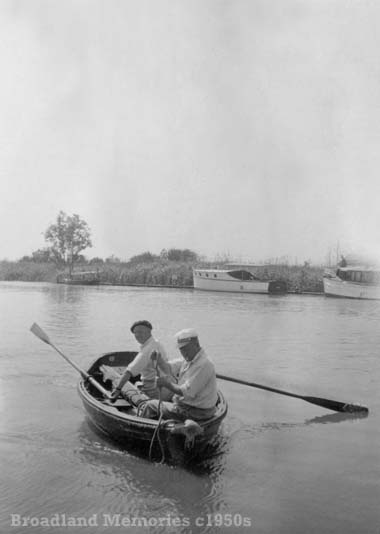
The gentlemen of the holiday party in the dinghy.
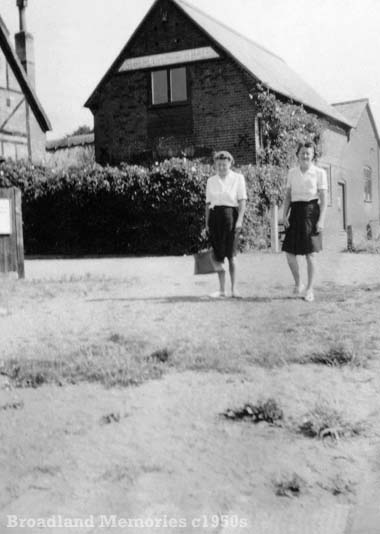
Horning in the early 1950s, with St Benet’s Church Hall in the background.