Designed & maintained by Carol Gingell

© C.Gingell 2006-
© Broadland Memories 2006-


VICTORIA
By Mike Barnes
John Loynes is generally regarded as the father of the Broadland holiday business. We regard him so, because so many latter-
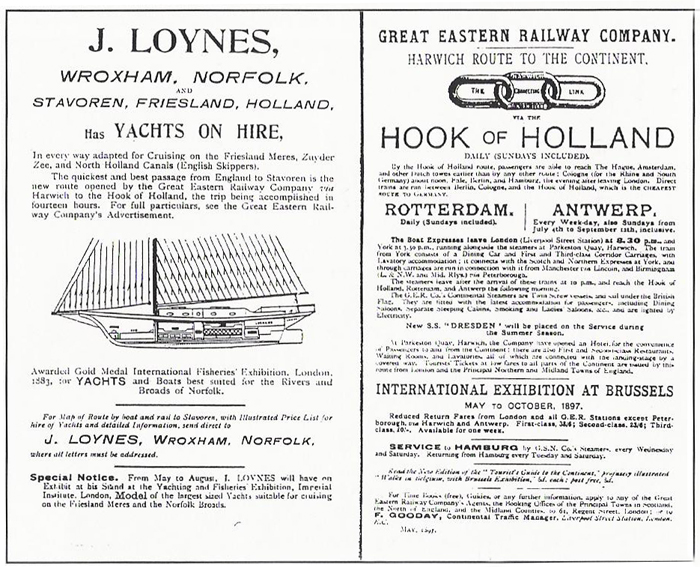
Loynes started to build sailing craft soon after and by the early 1880s, he had also started letting boats from Wroxham, influenced it is said, by the tendency of some of his customers to sail from Elm Hill round to Wroxham and then leave their boat there for him to move back. Indeed, his early advertisements show yachts of 13ft-
What perhaps marked him apart from other Broadland pioneers, was his view of the holiday trade as being more than just an ancillary activity to a boatbuilding yard and uniquely, he was the first to extend his horizons beyond the confines of Broadland. It is this that has rightfully given rise to his epitaph of him being the father of the Broadland Holiday industry.
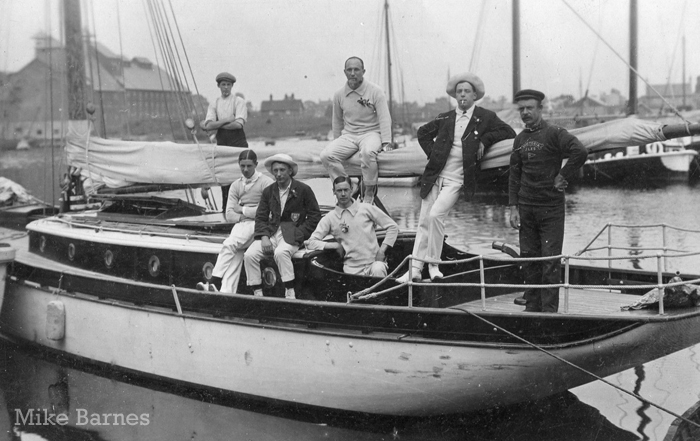
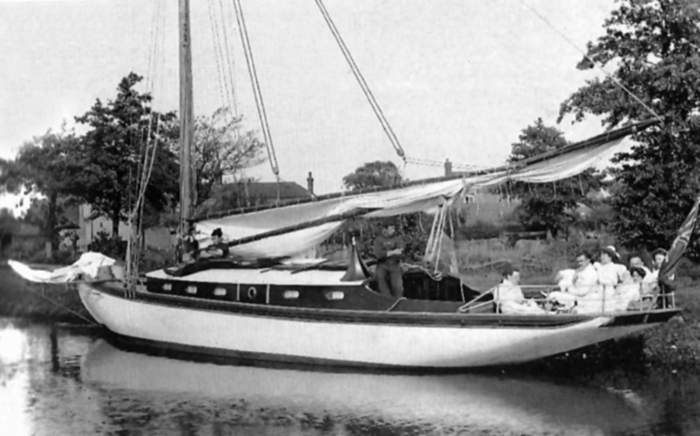
Loynes launched the yacht Victoria in 1897, named no doubt after the Queen who enjoyed her Diamond Jubilee that same year. At over 38ft in length, 11ft beam and 9.55 tons TM (more like 12 tons displacement), she was a substantial yacht that was designed to accommodate up to 7 guests in two cabins, and two attendants in the forepeak. Her cutter stem and counter stern represented the newly popular design, that combined speed and sailing qualities with an extraordinary level of comfort by the standards of the day. She was one of three closely similar sister ships, the other two being the Coral and the Volunteer, that all provided a spacious counter no less than 8ft square to seat all the guests and yet they drew no more than 3ft 9ins, to enable them to navigate the whole Broads system.
Loynes built them however, with a new venture in mind, for they were also capable of crossing the channel. In fairness, many Broads boats have since gone abroad, taken with varying degrees of risk or foolhardiness, out to sea and away from the benign waters for which they were intended, but Victoria had sufficient freeboard to sail to Holland by design and yet still, unlike other boats of such capability, be handy and fast enough to sail well on inland water. In this instance, the inland water in question was besides the Broads, the Dutch inland waterways off the Zuider Zee from Stavoren up to Sneek, an area stunningly similar to Norfolk.
Loynes had by 1897, set up a yachting station in Stavoren, where he operated several boats including the Spree and Enterprise as well Victoria and her sister ships, that cruised these beautiful Dutch waters in the summer months, returning to Wroxham at the end of each season for wintering and annual maintenance. Loynes in effect exported a by now tried and tested Broads holiday to the Dutch Waterways when as far as we know, there was no comparable competition and the newly established cross channel rail services lent practicality to the venture. Prior to this, a foreign holiday would have been the preserve of only the very rich, however Loynes put yachting abroad within the reach of the emergent middle class.
Who knows how well the venture may have gone for Loynes, had not the Boer War intervened and bought matters to a premature end. Our two countries were not directly at war, but there was considerable anti-
Victoria, Coral and Volunteer went back into hire on the Broads and remained thus so with Loynes, eventually under the Blakes banner when the company joined the new co-
We are indebted, for what we know of the Victoria today, to her principle post war owner; a school teacher who bought the boat in the 1960s, put her back to her original name and set about trying to unravel her past. Initially this was simply so that he could resolve the Ships Registry entry that erroneously still had Loynes down as owner, as the port authority at Yarmouth was being a bit difficult over updating the entry in his favour as owner. Although he could attest to the legitimacy of his purchase, he could not prove an audit trail back to Loynes who, as far as the Registry were concerned, was still the owner regardless of whether he was dead or alive. The purchase by unknown Dutch nationals on the eve of war was understandably hurried and in respect to the boats registry record, the transaction was incomplete. Of the war years; nothing is known at all and the registry only relented when they received confirmation of the original sale from Loynes & Sons as a company some 25 year after the event, and from a character called Bert Buffery, an intervening owner who had bought the boat after the war from a Belgian national.
Bufferys’ brief ownership adds a certain colour to the story in the best traditions of an ex-
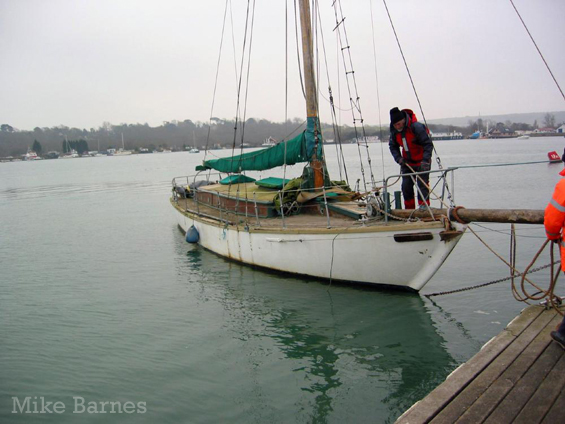
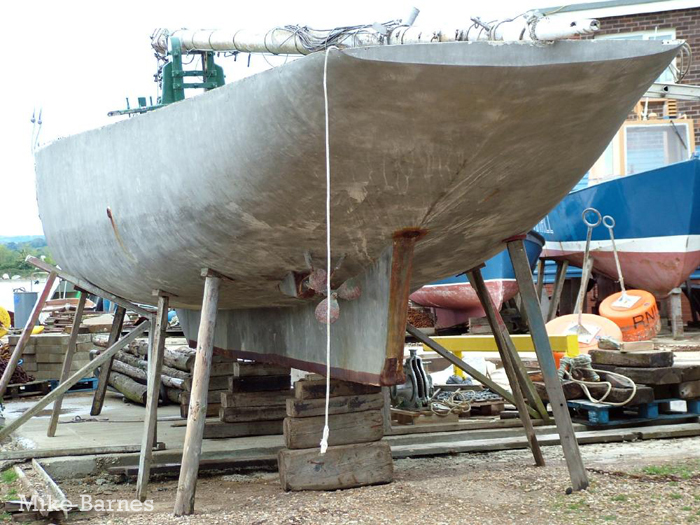
I am grateful to Mike Sparkes of the Wherry Trust and RCC member Herm Salmon for passing news of the emergence of Victoria to me in the summer of 2006, when she was finally recognised as a Broads boat by a handful of people with a Norfolk interest. She was apparently by then in a somewhat sorry state, laid up ashore on the Isle of Wight and initial reports were not in the least bit encouraging. It was known that she had been at some point in her recent past, sheathed in ferro-
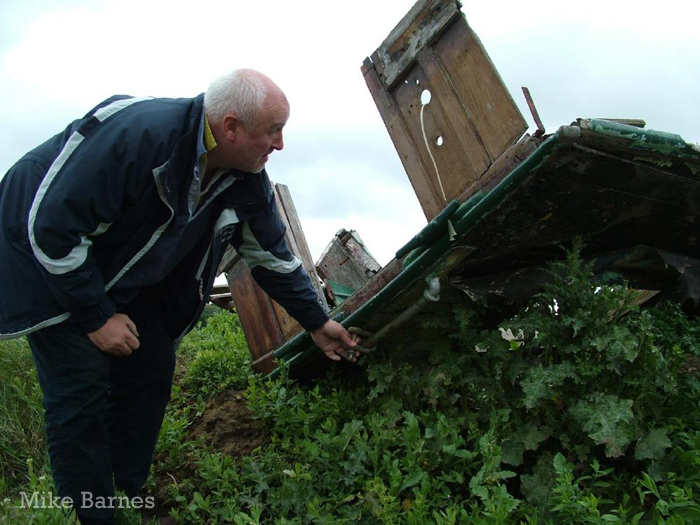
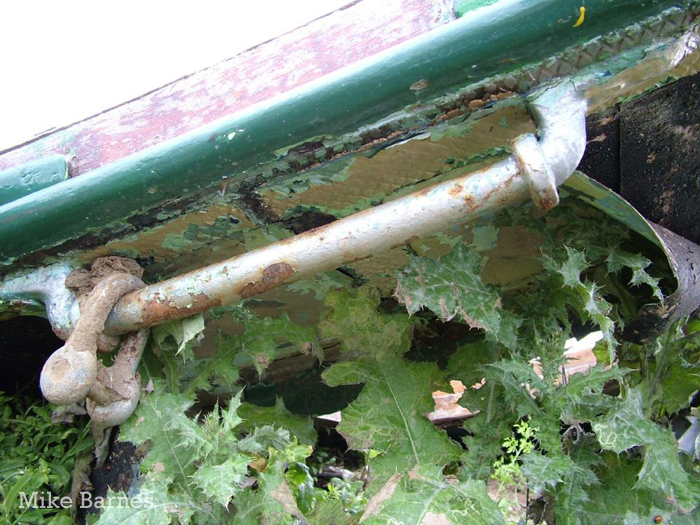
The new owner, incensed by a quote for restoration from the real world and yet still set on sailing the elderly and by then obviously unfit vessel to the other end of the world, set about the work himself and proceeded to gut the boat. Sadly, that is as far as he got with things and the yard are left with the remains thereof and storage bill for same that at the time of our visit, remained unpaid. It is often said that the show is never over until the fat lady sings, but for Victoria the end must be nigh. The only faint glimmer of hope is that whilst ferro isn’t the kindest thing to be done to the outside of an old wooden boat, the sheathing of Victoria is amongst the best ferro work I have ever seen and the she remains in fair shape as a concrete hull, albeit that the wooden fabric is quietly disintegrating within, but seemingly without other ill effect. The operation had clearly saved the boat from an earlier fate some 20 years before and it is still quite literally as stiff as the proverbial pavement to which it is now related! The same cannot however be said of the deck, superstructure and interior, all of which were relatively intact up until about two years ago but now lie piled up ready for bonfire night. The cabin sides were 1 ¼” teak, and by the look of it, so was much of the interior, discarded not by reason of deterioration then, but simply as they were not to the taste of the new owner. One can muse at what might have been had we known about the boat a little sooner, but then hindsight is amongst the cheapest of all commodities and nothing lasts forever, least of all an old Broads yacht far from home.
Mike Barnes
September 2007