
Designed & maintained by Carol Gingell

© C.Gingell 2006-
© Broadland Memories 2006-


Looking back at some of the many historic images of the riverside at Potter Heigham, the Bridge Hotel was once a prominent landmark, much photographed over the years due to its close proximity to the medieval bridge. Most sources state that the Bridge Hotel was built at the turn of the 20th century, replacing an old wherryman’s hostelry called The Waterman’s Arms. In 2016, I purchased a collection of pages with photographs that had been taken from a Victorian photo album, mainly featuring trips on the Norfolk Broads. They included several family group shots aboard the pleasure wherries Gladys and The Eagle, but also captured some well known landmarks including the Bridge Hotel at Potter Heigham. The clothing and the hats worn by the group were very much 1880s in style, and the presence of an invitation to the Norwich Angling Club annual dinner in December 1885 provided further evidence to substantiate that. As this would push the build date for the hotel back by 10-
Studying the hotel a little closer, I noticed that the large sign hanging on the front carried the name of the Waterman’s Arms, meaning that the new hotel retained the original name when it was built. Interestingly, studying it further, I noticed that the building behind with the chimney had writing on the gable end. It too bears the name Waterman’s Arms. This is clearly the original pub, still in situ. I can’t make out all of the lettering but it reads Accommodation on the top line, followed by what appears to be something about Yachts or Yachting, then Good Sta…. (Staithe perhaps?) and , finally, Bullards Fine Norwich Ales, owners of both the original Waterman’s Arms and the new hotel. Was it newly built when this was taken, and when did the name change?
My first point of reference was to haul every late Victorian Norfolk Broads book I have off the shelf and search for mentions of either the Waterman’s Arms or The Bridge Hotel. The earliest record I have in print comes from George Christopher Davies who, in the 1882 edition of The Handbook to the Rivers and Broads of Norfolk and Suffolk, wrote: “At the bridge is the ‘Waterman’s Arms’, where one or two bedrooms, and a small parlour, all scrupulously clean, are obtainable.” This presumably refers to the original inn. Incidentally, he also mentions the small thatched building you can see: “Just by the bridge, in a sort of wooden ‘Peggoty’s Hut’, lives Applegate who has good boats, sailing and rowing, for hire, stowed away in a remarkably neat boat-
The 7th edition of Ernest Suffling’s Land of The Broads, published in 1895, lists the Bridge Hotel with William Knights as landlord. In his 1903 guide The Norfolk Broads, William Dutt wrote: “The old Waterman’s Arms has been pulled down and a new inn built, and it will not be surprising if before long something is said about building a new bridge.” I wonder if this is where the often quoted turn of the century date for the new hotel originates.This gives us a date of somewhere between 1882 and 1895 for the new hotel being built -
I turned to the local trade directories, which can be found online via the county council’s Norfolk Resources website, and also the 1881 and 1891 census returns. The 1881 census places Edward Laws as publican at the Waterman’s Arms, living there with his wife Ann. Kelly’s 1883 Directory also lists Laws at the pub as both victualler and boatman. Whether this means he was a waterman, or that he had boats for hire I don’t know. William Whites History, Gazetteer & Directory of Norfolk of 1890 shows that a William Knights was now listed as the landlord of The Waterman’s Arms. By the time the census was recorded in the following year, it had become the Bridge Hotel. William’s wife Elizabeth and two year old son Frederick were also living at the hotel.
The Norfolk Pubs website gives dates of 1881 to c1888 for Edward Laws and 1890 to 1908 for William Knights at The Waterman’s Arms and Bridge Hotel. It also mentions that The Norfolk Chronicle of the 25th of August 1888 reported that Bullards had applied for a spirit licence. It was opposed by Morgans Brewery, who owned the nearby Falgate Inn, and the application was refused by magistrates. Would a small ale house have applied for a spirit licence I wonder. Perhaps this is the biggest clue in pinpointing the build date, with the brewery applying for a spirit licence for the new Waterman’s Arms hotel?
He had found the perfect Dutch interior, one to his liking; and to retain his hold on the picture, he kept the landlady answering the questions which he artfully plied her.
‘Lonely in winter?
Oh no sir; its never lonely in this inn. What with being so near to the bridge, there’s such a lot of callin’, both winter an’ summer. Sometimes, perhaps, of a winter’s night, we’ve time to sit down, but never in summer.
Go to church at Martham?
We’re Heigham Parish. We goes to Martham once a year, at Christmas maybe. It’s a fine sight, Martham Church. It’s as big as a town. The noise out yonder? It must be the boys and the men at bowls.
‘Let us go and see the men at bowls’ cried Renard, with characteristic faithlessness deserting an old picture for the sight of a new one.
A bit of a garden and a longish strip of turf lay between the back of the inn and a low mass of shrubbery. On the greensward were a dozen or more rustics. A huge pitcher and some beer-
It seems, from photographic and documentary cross referencing, that the new Waterman’s Arms was built somewhere between 1882 and 1890, with a date of 1886 to 1888 seeming most likely. The date when the old inn was demolished is still unknown, but it sounds as though it may have stood for a few years.
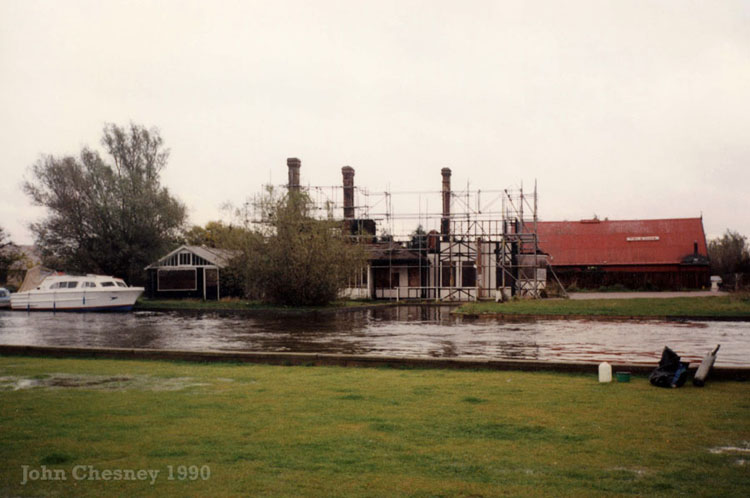
The remnants of the building were shored up with scaffolding and remained that way for several years until it was finally demolished. The land on which the hotel stood is now used as a car park by the owners of the riverside bungalows which line the banks of the River Thurne, but the footprint of the building can still be seen. You can make out rooms and corridors amidst the floor tiles on the surface of the car park, the curve of the entrance foyer. Close your eyes and you can almost hear the clack of bowls on the lawn, the clink of beer glasses behind the bar, and laughter from within the brightly painted walls.

The remains of the Bridge Hotel at Potter Heigham, photographed in 2016.


What remains of the Bridge Hotel may soon disappear all together as plans were submitted in February 2021 for redevelopment of the site with ambitious, and somewhat controversial proposals for a restaurant and twelve holiday flats to be erected on the land. Watch this space!
If you have any memories or photographs (especially interior shots) of The Bridge Hotel then please do get in contact.
You can view the collection of 1880s photographs to which the image of the new Waterman’s Arms belongs in the Pre 1900 Gallery.

Photograph of Potter Heigham Bridge and The Waterman’s Arms from the 1880s photo album.
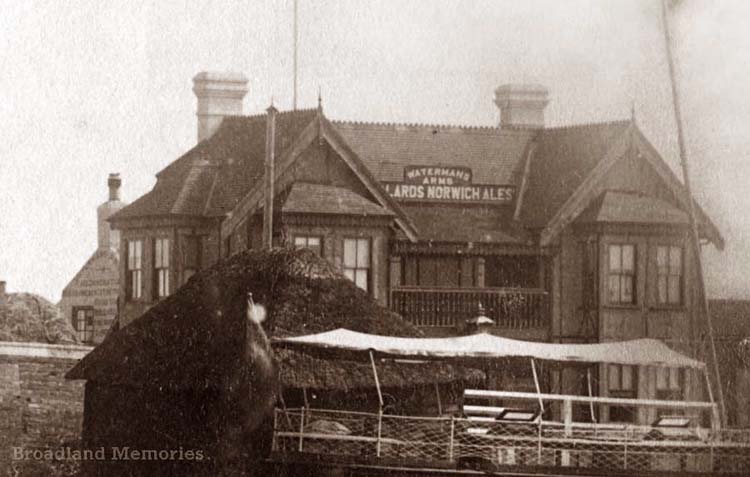
Close-

The photograph above is one of the earliest images of Potter Heigham I have, with the original Waterman’s Arms seen on the left, looking downstream towards the bridge. It is believed to have been taken by George Christopher Davies, probably c1880.
Perhaps the most interesting and enlightening mention of The Waterman’s Arms is to be found in Anna Bowman Dodd’s “On The Broads” which was published by Macmillan and Co Ltd in 1896. The holiday recalled in the book would probably have been taken at least a year or two before the publishing date, if not more. It paints a colourful portrait of Potter Heigham during the summer, the old pub, the landlady (Elizabeth Knights?) and the clientèle. It clearly mentions the new, brightly painted inn and being led through to see the old parlour:
“He (Renard) led us triumphantly onward, along the the river to the inn. This was a path as crowded as a city’s thoroughfare. Troops of strollers were abroad on the meadows; sailors, skippers, gentlemen, young girls, dogs and mature matrons passed us by. The inn’s timbered structure, close beside a three-
‘A friend made since noon,’ maliciously explained Miss Violet.
‘The friend of an hour, but true as steel, as you’ll see,’ retorted Renard; and his boast, we found, was no vain one.
The inn landlady was as busy as a woman could be with ‘five dinners, a lawn tea, an’ ten to give beds to’; but she came forth with composure in her smile. There had been no mistake whatever in Renard’s estimate of her feeling on his behalf. White flour paste to her elbow, she was yet eagerly anxious to learn the wishes of the tall gentleman with the masterful ways.
Renard was merciful; he merely wished to engage in the agreeable traffic of a brief conversation. He had liked the looks of her kitchen, the old one, he remarked, with its dark interior and brown walls; he had bought his friends to see its fine colour. This was clearly a severe blow to the amiable landlady’s pride in the newer room beyond, ablaze with light and the whites of its new walls and ceilings. But she led us to the old chamber with a smile. Presently she sent her own eyes abroad on a quest of discovery. What indeed could there be to admire in this dark, dull room, with its high old settles and its worn deal tables! Two old men, with pipes in their mouths, sat motionless on the benches. Renard looked at them with a covetous eye. Such models as they would be, in their faded corduroys and dingy vests and kerchiefs, and in the rich gloom of this old kitchen, for – well, for a dozen pictures.
‘See, beyond, what a bit of perspective! Those lights, and the blonde girls, working about, and those bentbacks reaching for the brasses hung on the walls – that head there, rising out of the steaming pots on the range, and the yellow sun flooding the walls.’
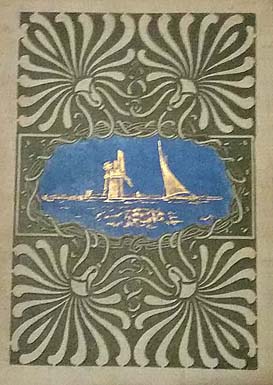
“On The Broads” by Anna Bowman Dodd
The newly christened Bridge Hotel was obviously a popular watering hole for locals and holidaymakers alike in the 1890s. It’s popularity continued through the 20th century -
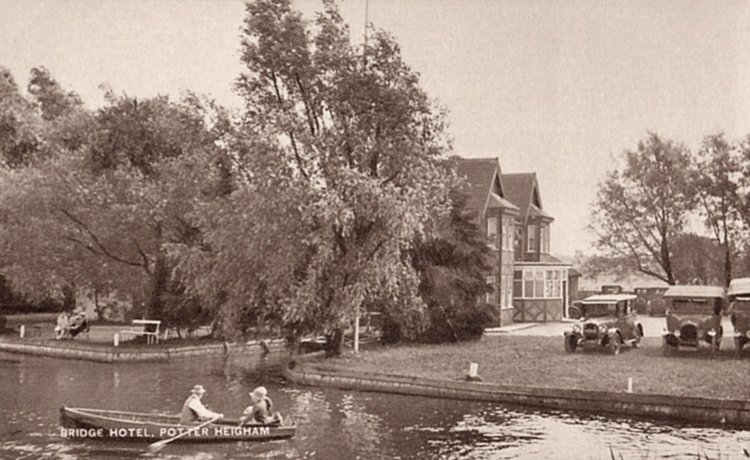
The Bridge Hotel pictured in the 1920s.

The Bridge Hotel in the 1970s.
© Carol Gingell 2016 & 2021