
Designed & maintained by Carol Gingell

© C.Gingell 2006-
© Broadland Memories 2006-


Postcards of the Norfolk Broads
Wroxham

Page 1, 2

The Horseshoes Hotel in Hoveton pictured c1900. The sign on the end of the building advertises “Smiths Norfolk Broads Tour” and the gentleman standing in front of the hotel is presumably George Smith, who was the licensee of the hotel at this time. George and his sons ran a small fleet of passenger launches here and eventually began to expand into the holiday hire market with cabin yachts and eventually motor cruisers. His “Broads Tours” business moved further upstream near the railway bridge and was eventually sold to Charles Hannaford in the mid 1930s who expanded the fleet and business further. The Broads Tours name survives to this day at Wroxham.

Station Road in Hoveton c1905. This photograph was taken towards the Northern end of Station Road just down from where it now joins the B1354 Coltishall/Horning Road. The house on the right still stands, and the station itself can be seen in the background on the left. The area immediately on the left of the photograph is now the far end of Roy’s car park.
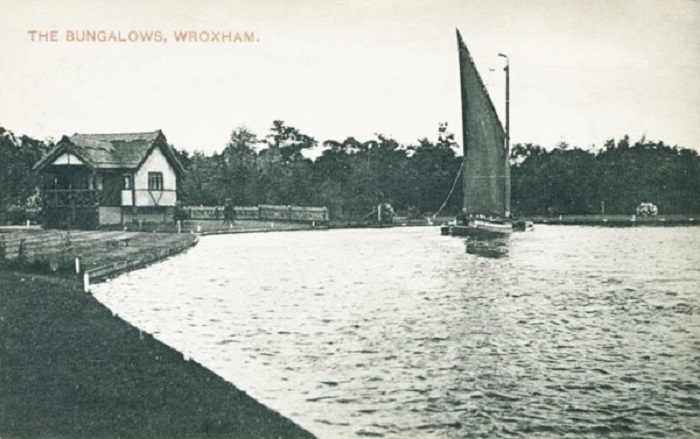
A wherry passes a riverside bungalow at Wroxham c1905/1910.

This postcard featuring Wroxham Broad was posted in 1908.
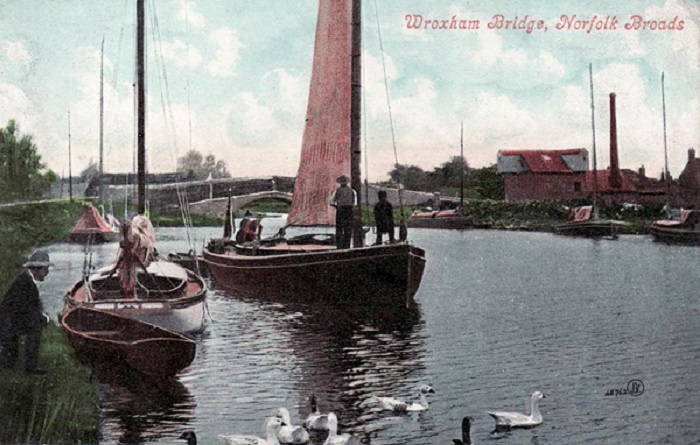
Although this postcard of Wroxham Bridge was posted in 1909, it is actually a colourized version of a photograph which was taken by John Payne Jennings around 1890. John Loynes had established his boatyard just below the bridge, on the left, in the late 1880s, having moved to the Northern rivers from his original base in Norwich.
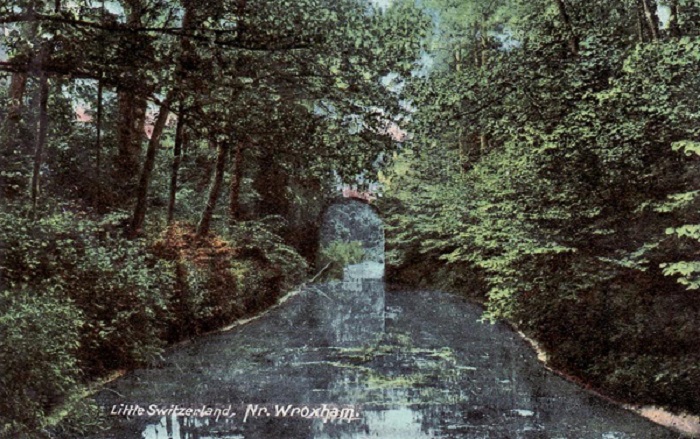
One of the entrance dykes to Little Switzerland on the River Bure, dating from c1910. Little Switzerland is a series of chalk marl pits, located between Wroxham and Belaugh, from which thousands of tonnes of chalk was quarried during the 19th century. The channels leading off the Bure were cut to enable small wherries and lighters to get right up to the pits to load the marl for transportation around the Broads. The marl was apparently a useful aid to turnip growing when applied to the fields, and was also transported to lime kilns and cement works in the area. Quarrying ceased around 1875 and the steep slopes created by digging out the chalk were planted with coniferous woodland. It is also recorded that a mastedon, a form of prehistoric elephant, was discovered here in the early 19th century.

Wherry at Wroxham Bridge c1910.

Another view of Station Road in Hoveton, looking back towards the centre of the village, which probably dates from the late 1940s or early 1950s. This is a view which has changed considerably over the years and shows the Broads Hotel on the far left. The garage on the left is still there, now known as Station Road Garage, the Broads Hotel was heavily altered and extended and now also occupies the area where the little restaurant building is seen above. The shop seen on the right hand side of the road in the middle of the photograph has been rebuilt and is now Massingham Bros. butchers.

The view looking upstream from Wroxham Bridge, with the Kings Head staithe on the right, dating from the early 1950s.
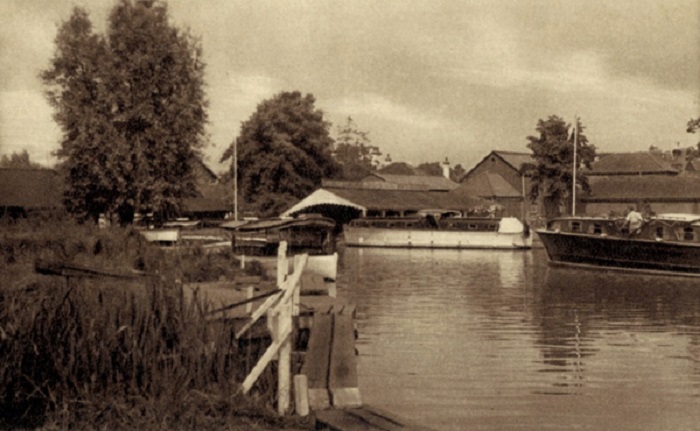
Another postcard dating from the 1950s taken from just above Wroxham Bridge, looking across to the Kings Head staithe, with the Three Horseshoes pub also visible in the background.

Also dating from the 1950s, this photograph of Wroxham Bridge shows Jack Powles boatsheds on the right. The yacht moored in the foreground was the 20ft, 3 berth “Cosmea” which was available to hire from Easticks of Acle. A weeks hire in 1952 cost bewteen £11 and £15 10 shillings.
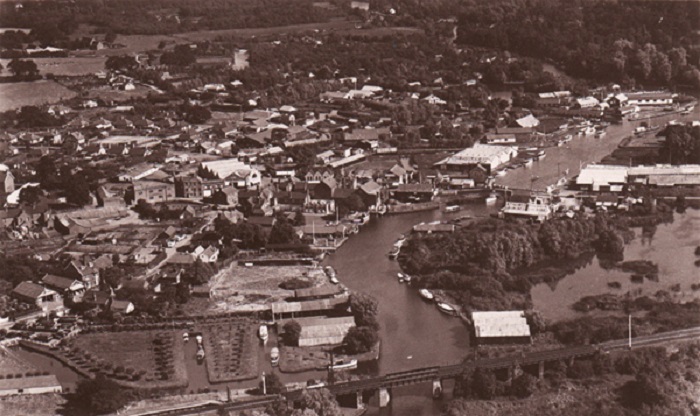
An aerial view of Wroxham and Hoveton which probably dates from the 1950s.
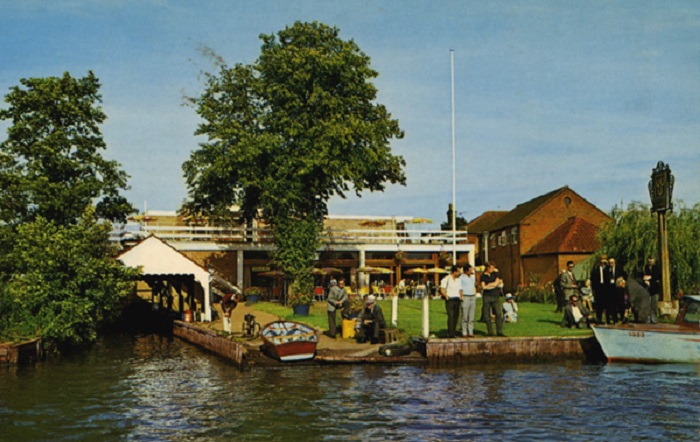
The Three Horseshoes at Hoveton/Wroxham, pictured in the late 1960s. The Horseshoes Hotel seen earlier amongst this collection had been heavily altered c1900 and a more substantial brick building replaced the original wooden cladding. In 1961, the pub underwent further building work which included the balcony area seen above. The Horseshoes is currently closed and has been boarded up.
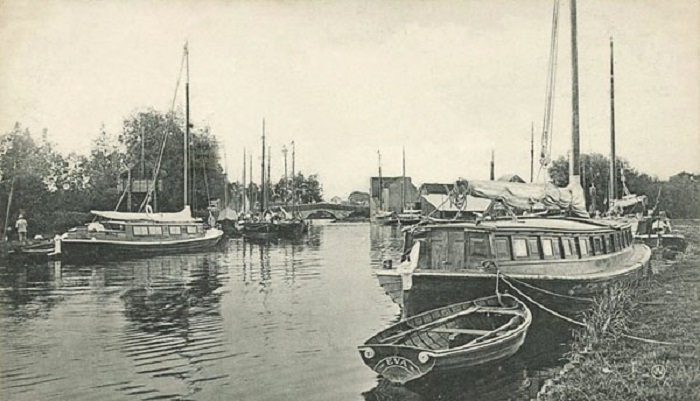
Pleasure wherries at Wroxham c1906. I’ve not been able to identify the wherry on the right, but the pleasure wherry on the opposite bank is “Victory” which was part of Ernest Collins fleet. Victory slept seven in three cabins and was hired with two attendants. The hire period at this time extended over just four months, from May to August, and the cost of a weeks hire in 1909 was between £8 to £10.

Another unidentified pleasure wherry, photographed from Wroxham Bridge c1910.

Another busy river scene, photographed from Wroxham Bridge c1910. The card must have been sold at the Hoveton branch of Roys as lettering on the left of the card reads; “Roys provide everything for yachting”.
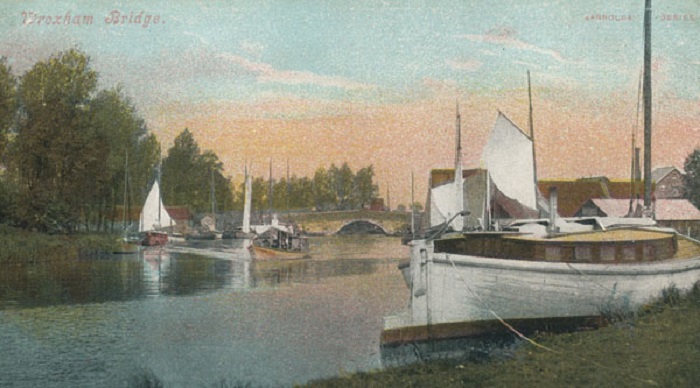
Another view of Wroxham Bridge, dated to 1909. This card was submitted to the archive by Stella van der Gucht and was bought as a souvenir by her grandparents who holidayed in the area in 1908 and 1909.

The passenger steamer “Queen of the Broads” heads downstream on the River Bure at Wroxham in this c1910 postcard. Built at Cobholm in Great Yarmouth and launched in 1889, the Queen of the Broads was owned by the Yarmouth and Gorleston Steam Company and ran regular day trips to Wroxham. Leaving Yarmouth at 9.20am, the steamer would arrive in Wroxham at 1.20pm, departing for home an hour later. Passengers could take a circular tour of the Broads, disembarking from the Queen of the Broads at Wroxham, before heading to Norwich by train to pick up her sister ship the “Pride of the Yare” which would return them to Great Yarmouth along the River Yare. The cost for a return trip to Wroxham and back was 2/6 and the circular tour was 3/ per person. On the right is the pleasure wherry “Enchantress”

Sailing on the River Bure at Wroxham, postmarked in 1911. I’m not certain of the exact location of the trestle mill which can be seen on the right.

Riverside bungalows at Wroxham, posted in 1917. The later photograph, below, of the same building captioned this as being called “Bure Banks”, but it is now better known as “Willow Bend”.

Another postcard which features “Willow Bend” on the River Bure at Wroxham, this time dated to 1933. The bungalow was one of several properties which were built along Beech Road during the late Victorian/Edwardian era on land which had been part of the Wroxham House estate.

A 1920s postcard which shows the “Beehive” at the entrance to Daisy Broad. This later became well known as the Beehive provisions store, owned by the Brinkcraft Ltd boatyard.

Another view of the riverside bungalows at Wroxham, posted in 1931.

This range of villas would have looked more at home in the Mediterranean but were actually situated in Daisy Broad at Hoveton, opposite Royall’s boatyard. Ordnance Survey maps indicate that these were actually built in the 1920s and I would imagine this card dates to the 1930s. The names I have for them may not be the originals, but from left to right they were Kia Manzi, Southernholme and Broadwaters. The earliest reference I have for them is in the 1958 Hoseason’s brochure when Southernholme was listed as a 5-
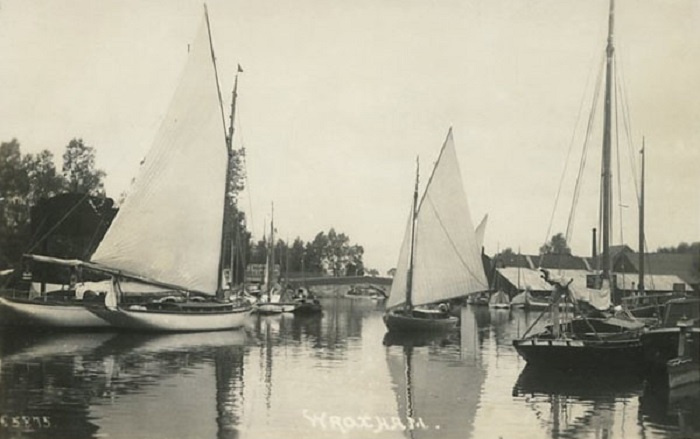
Posted in 1927, this card shows a very busy river scene at Wroxham Bridge. I’m unsure whether the wherry yachts on the left were part of the Loynes or Collins fleet and, as such, cannot be certain of an identification.

This postcard shows the range of buildings on the corner of Norwich Road and Station Road, looking up towards Wroxham Bridge, and dates from 1925. On the right was the grocery store which was run by Mrs Ward. To the left of that was Ward’s Telegraphic Stores and Post Office

The interior of Ward’s Grocery store at Hoveton c1930s. This is just so wonderfully evocative of the era and a far cry from modern grocery shopping!

Dating from the late 1960s, this shows another view of the same building which had by then become part of the Roys’ empire. It is now home to Roys’ “Zone” ladies fashion shop.