
Designed & maintained by Carol Gingell

© C.Gingell 2006-
© Broadland Memories 2006-


 1950s History
1950s Memories
1950s History
1950s Memories
1950s Photo Gallery




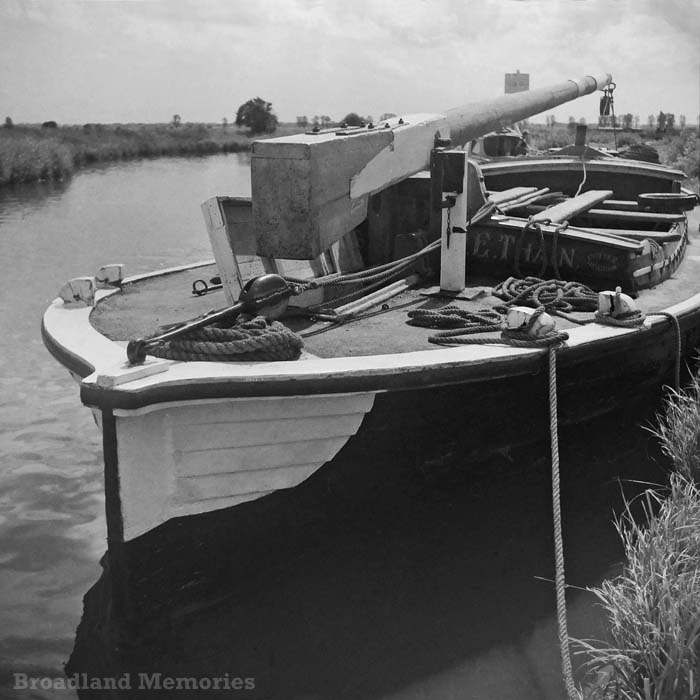


The first of a series of photographs of the “Lord Roberts” which were taken at Ludham Bridge in the 1950s.
The “Lord Roberts” was built for Dionysius (Di) Thain at West Somerton by Ben Benns in the 1890s. Benns was a ‘journeyman’ boat builder, travelling to wherever he was needed to build boats. It is thought that he probably spent around three years building the Lord Roberts, and would most likely have been working on more than one boat, in different areas during this time.
As can be seen, the Lord Roberts was still owned by the Thain family here and continued to be worked by them up until the late 1960s when she was gifted to the Norfolk Wherry Trust.
Di Thain was listed on the 1881 census as living at Staithe House in West Somerton with his wife Lydia and eight children. He was recorded as being a coal merchant whilst two of his sons, Joseph (19) and Dionysius Jnr (12) were listed as wherrymen. 22 year old Robert Powley, also a wherryman, was boarding with the family when the census was taken. Di Thain also owned the wherry “Waveney”, built by William Brighton at Bungay and renamed “Eva Rose” by Thain. It was later converted for use as a motor, pleasure wherry and given yet a new name, “Black Prince”.
A view of the “Lord Roberts” from the stern end. You can see the remains of Beaumont’s Mill in the background. As previously mentioned, she was gifted to the Norfolk Wherry Trust in the late 1960s but ended up sinking in a dyke at Womack c1970, and there she lay for the next 13 years. A 1980 newspaper article reported that the Wherry Trust were planning to raise the Lord Roberts and, if viable, would restore her and use her for pleasure trips. At the same time, the Trust launched an appeal to raise £12,000 to build a new wherry base at Womack for Albion and the idea of building a brand new trading wherry from scratch was also mooted. In 1983, she was successfully raised by Nigel Royall, Gordon Archer and his son Paul with the assistance of teenagers Kean Howtree and Phillip Collin. She took just 40 minutes to raise with pumps and repairs were carried out to seal leaks in the hull. The winding gear was said to be still intact and an old tar brush was sitting on the wherry exactly where it had been left prior to sinking. The team later made the journey with Lord Roberts by river to Wroxham but, sadly, The Wherry Trust were unable to have her restored as the ongoing maintenance costs to keep Albion sailing meant that funds were just not available. It was estimated that the cost of renovation would be between £50-
The final photograph of “Lord Roberts” at Ludham Bridge in the 1950s. There is an interesting set of photographs of the wherry, taken by Pete Sanderson shortly after she was moved to Wroxham in 1983, which can be found in the 1980s Gallery.
One of the “Grebe” class, photographed on the River Bure at St Benet’s Abbey.
Another in the sequence of photographs of “Grebe” at St Benet’s Abbey.
Another of the “Grebe’s” photographed at St Benet’s Abbey. The class were described as being: “smart, sporty craft designed to give a sailing performance comparable with a half-
South Walsham outer Broad, pictured in the 1950s.
A riverside meal for the two crews, with what looks like “Grebe II” or possibly “Grebe IV” seen in the background.
The two “Grebe’s” seen moored in the foreground at what looks like Horsey Dyke.
Another small collection of photographs which were taken during the 1950s. They appear to show a group of four friends who hired two of the “Grebe” class of sailing cruisers from Loynes boatyard. They are especially interesting as the set included quite a few photos of the trading wherry Lord Roberts which was owned by the Thain family.
An as yet, unidentified sailing cruiser, pictured approaching.
Another photograph of the river cruiser seen above, pictured during the 1950s.
One of the holiday party on board one of the Grebe class at Great Yarmouth Yacht Station. Ahead is “Whippet 6”, a 2 berth sailing cruiser which was hired from Ernest Collins at Wroxham. The cost of a week’s hire of “Whippet” during the main summer season in 1956 was £12 10 shillings.
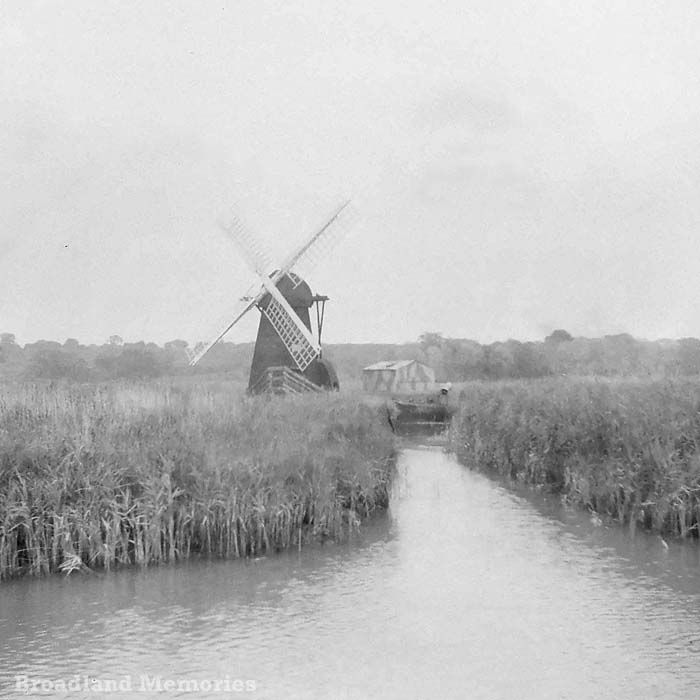
Herringfleet Smock Mill on the River Waveney. The hut beside it appears to be painted in camouflage paint -
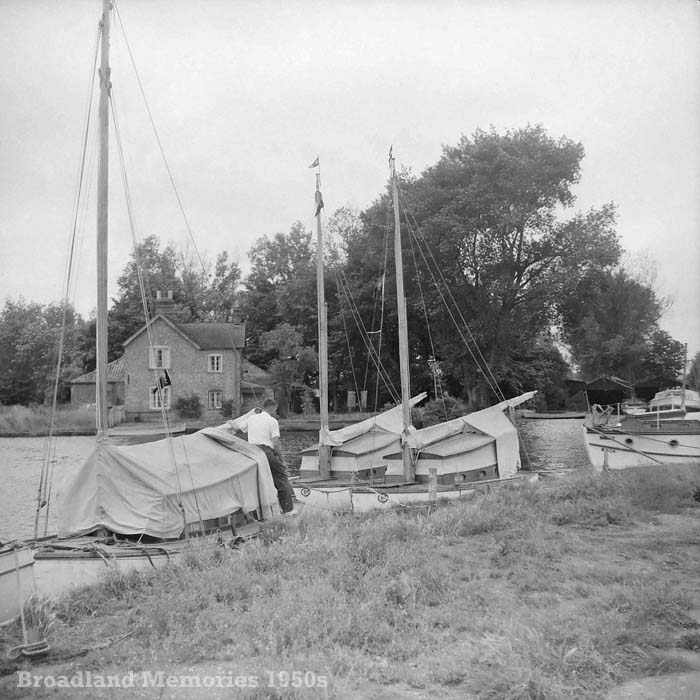
The view looking across the River Waveney from Beccles Yacht Station. The two “Grebe” sailing cruisers can be seen moored together in the centre of the photograph. Built by Loynes boatyard at Wroxham in the early 1950s, there were eventually six in this 2 berth class. In 1958, one of the Grebe’s could be hired for between £10 15 shillings and £18 15 shillings, depending on the time of year.
Thurne Dyke Mill, pictured in the 1950s. Built in the 1820s by England of Ludham, by the late 1940s the mill had become pretty much derelict. It was bought in 1949, and subsequently restored by Bob Morse.
St Benet’s Level Mill, viewed from Thurne Dyke. Originally built c1775, the mill was partially rebuilt in the late 1890s when an extra 10ft was added to it’s height.
Another view taken from Thurne Dyke, with the trading wherry “Lord Roberts” passing on the main river. The yacht on the left is one of John Loynes 34ft “Ripple” Class. (Thanks to Mat Gravener for providing an identification)