
Designed & maintained by Carol Gingell

© C.Gingell 2006-
© Broadland Memories 2006-


 1950s History
1950s Memories
1950s History
1950s Memories
1950s Photo Gallery
This next, large collection of photographs comes from two albums which span the years 1950 to 1957. They included a comprehensive set of images documenting holidays taken on the Broads, initially as a group of friends, but later returning as a family group with two young children. The first motor cruiser the group hired was from George Smith and Sons at Wroxham, thereafter they were loyal Herbert Woods customers. I’ve had to whittle them down slightly to remove fuzzy or repetitive images, but it is still a large collection with some super shots of the Herbert Woods fleet, and they are shown in chronological order. As the 1950s dawned, some foodstuffs were still on ration and “emergency ration cards” needed to be obtained from your local Food Office prior to departure. Provisions could be ordered in advance from the nearest store to your boatyard and would be waiting on board for you, rationed goods only handed over upon presentation of your emergency card and relevant coupons. Fresh supplies of meat, bread and vegetables could be obtained from one of the village or riverside stores as you cruised, fresh milk often being sought from local farms in a little milk pail which was included in the boat’s inventory. Few hire cruisers had bathing facilities on board, and showers were a way in the future, but some yachting stations, riverside hotels and inns offered the availability of hot baths to boaters. Hot meals and afternoon teas could be found at many establishments, although some were only by advance, telephone order. Many holidaymakers still travelled to the Broads by train, although the motor car was becoming more popular and affordable, whilst taxis, buses and (in some cases) rowing boat ferries, concluded the journey to your chosen boatyard. New motor cruisers were being built by the boatyards, following the refurbishment of what remained of the pre-

The first photograph from 1950 shows the party’s holiday cruiser which looks to be one of the “Spangle” class from George Smith and Sons of Wroxham. These 29ft, 4 berth motor cruisers were powered by a Brooke “Empire” engine and were built in 1931 and 1932. There was a toilet/dressing room to the fore, with a two berth cabin behind. The centre wheelhouse included a stove and sink, whilst another two berth, aft cabin with toilet compartment completed the accommodation. The cabins were fitted out in solid teak according to an earlier brochure. The cost of a week’s hire in the early 1950s was between £24 and £34 depending on the time of year.

Another photograph of B475 “Spangle” from 1950. As Spangle could only accommodate four people, I can only assume that the group hired more than one craft for their trip otherwise things must have been rather snug on board!

The crew in the wheelhouse of “Spangle”.

Underway on the Norfolk Broads in 1950 – the mill in the background is believed to be Mautby Marsh Farm on the River Bure (with thanks to Bob Paterson and Thomas Glastonbury for the identification).

Two of the holiday party enjoying a spot of fishing from the coach roof.


One of the ladies in the group at the helm of “Spangle” in 1950.
Womack Dyke pictured in 1950. The little summer house and windmill you can see in the background stood at the entrance of the cut which led up to the house “Little Holland”. One of the Martham Boat Building & Development Company’s “Japonica” class is heading down the dyke. (Thanks to Mat Gravener for providing an identification)

A closer view of the summer house and windmill with “Little Holland” itself seen in the background.

Two of the crew in the dinghy which would have been included within the cost of a week’s hire. I would think that they must have paid extra to have the outboard on the back.

One of the most familiar, and often photographed, buildings on the Broads. This is, of course, “Dutch Tutch” at Potter Heigham which began life as a helter skelter which stood at the entrance to Britannia Pier at Great Yarmouth from around 1902. The pier suffered a catastrophic fire in December 1909, and it was originally believed that the helter skelter was damaged in the fire too. However, it is now thought to have actually been removed from the pier c1908 and moved to Potter Heigham for use as a holiday home before the fire. The top, which was placed beside it, was used as an outside toilet.

I suspect that this was also taken at Potter Heigham in 1950.


I was a little puzzled by this photograph until I saw the next one which explains what we are seeing here -

Another photograph which shows the aftermath of a salt-
The Pleasure Boat Inn dyke at Hickling.

Passing through Great Yarmouth in 1950, the yachting station to the right. In the background is the old M&GN rail bridge which crossed the Bure en-

The final photograph from 1950 shows the “Queen of The Broads” which was probably the most well known and loved passenger steamer on the Broads. She was built by Critten’s boatyard at Cobholm Island, Great Yarmouth and launched in 1889, and for nearly 90 years plied her trade on the Yare and the Bure, carrying thousands of passengers and giving many their first taste of the Norfolk Broads. She was withdrawn from service in 1976 and broken up shortly afterwards.

In 1951, the photographer returned to the Broads, hiring B60 “Gleam of Light” from Herbert Woods at Potter Heigham. “Gleam” was one of the 36ft, 6 berth “Ring of Light” class which had been built at the Broads-

Five of the holiday party on board “Gleam of Light”. From bow to stern -
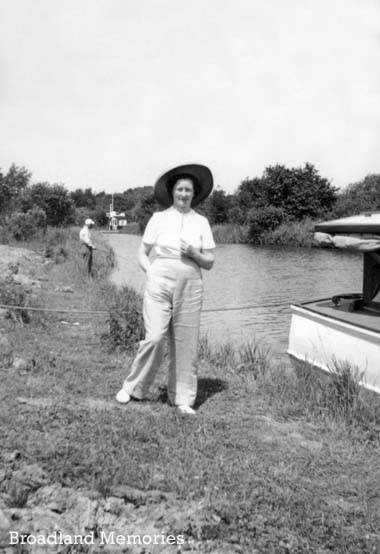

Womack Dyke appears to have been a favourite mooring spot for our photographer and his holiday party as there are several photos taken here during the first few years of visits. One of the crew is pictured here with the summerhouse and windmill at the entrance to “Little Holland” seen in the background.
One of the crew in the dinghy, taken at the same location. A short walk along the river bank would bring you into the very well served village of Ludham which boasted two pubs in the centre (The Kings Arms and the Bakers Arms), a post office, butchers, fishmonger, two general grocery stores, a hardware shop and a filling station. There was also a small gift shop at “Sunny Days”, which stood near the entrance to Womack Dyke.

I think this must have been taken in Womack Dyke too.


Fishing from on board “Gleam of Light” in 1951, location unknown.
The men-