
Designed & maintained by Carol Gingell

© C.Gingell 2006-
© Broadland Memories 2006-


 1900-1949 History
1900-1949 Memories
1900-1949 Gallery
1900-1949 History
1900-1949 Memories
1900-1949 Gallery
In 1908 and 1909, Harry Caston and his fiancée Lilian Child spent their summer holidays at Great Yarmouth with Harry’s parents, Henry and Maria, his brother Ernest and his fiancée Florence Jones. Their days were spent visiting the popular attractions of the era, in and around Yarmouth and also further afield in Norfolk and Suffolk. They took boat trips on the Norfolk Broads and out to sea and, in the evenings, enjoyed some of the entertainment at various establishments around the popular seaside resort. Along the way they bought postcards of the places they visited and, on the reverse, wrote a series of short notes about where they went and what they did. These postcards, plus the few photographs which were taken by Harry, were discovered many years later by their grand-
Harry Caston was born in 1883, hailed from Forest Gate and became a quantity surveyor. Lily was born in 1885 and worked in a stationers shop in Hornsey. It seems as though they may have visited Great Yarmouth in 1907, and continued to do so after they were married in 1910, travelling by train from London. Through his job as a surveyor, Harry had access to a camera and the photographs included here were taken by him and his brother Ernest. These, and more of the photos taken during their holidays can be found in the 1900-
Seaside resorts became hugely popular during the Victorian era but the origins of the appeal of some, such as Great Yarmouth, actually date back to the 18th century when they became fashionable destinations for the upper classes. In the mid 18th century Dr Richard Russell promoted the idea that seawater was a sort of miracle “cure-

1908
Tuesday 11th August 1908
Dull & cold
Went out before breakfast
Morning -
Afternoon -
Evening -

Harry did later own a car but apparently employed the services of a chauffeur and never drove himself. I’m sure that it would have been possible to hire a motor car, probably with a chauffeur, in 1908 but I think that the horse-
Ormesby Broad, along with Filby and Rollesby, was one of the popular tourist spots which attracted many visitors, with rowing boats available to hire from the landing stage at the Eels Foot Inn. In his guide the Norfolk Broads, published in 1903, William Dutt described the Trinity Broads thus: “The scenery of these broads is pleasantly varied. The shores are well wooded; there are quiet creeks not unlike those of Barton, islets fringed with fen sedge, willow herbs and purple-
Deciphering the notes written by Lily was rather difficult at times and her mention of going to see “The Gaiches” may be my misinterpretation of her words as I can find no reference to anything like this. It is likely that they went to one of the theatres in the evening so this may actually refer to a show.
There are quite a few references in Lily’s notes about going for a “drive” – although there were certainly motor cars around at this time, including “The Anglian” a three-
The landing stage at the Eels Foot Inn c1910

Wednesday 12th August 1908
Dull & Cold
Morning -
Afternoon -
Evening -
The East Anglian Tramway Order was approved in 1871 and a system of trams was originally intended to run from Southtown, all the way down the coast to Southwold but was eventually confined to the Yarmouth and Gorleston area. The tramway was divided into two parts, divided by the River Yare with the lifting Haven Bridge being unsuitable for trams to cross. The trams were originally horse-
The interior of the Winter Gardens at Great Yarmouth c1904
The last section which took the trams on to Caister-
The Winter Gardens were erected beside Wellington Pier in 1903, having originally been built in 1878 in Torquay where it was rather unsuccessful, it was bought by the Great Yarmouth Corporation for £1,300 and was transported round the cost on a barge. In dismantling, transporting and then re-

I take it that the “? Beauties” part of Lily’s notes questions the aesthetic qualities of the girls on show! George Gilbert was born in Norwich in 1857 and, as a young lad, did the classic of “running away to join the circus”. With Hannaford’s Travelling Circus he learnt equestrian and acrobatic skills and became an accomplished showman. It is reported that, after incurring an injury, he decided to move into circus management, staging various shows at the Agricultural Hall in Norwich during the 1890s. In 1898, he opened his first circus in Yarmouth on the site of the old bath house stables. It proved to be a huge success, and with the money he earned George Gilbert employed the services of the architect Ralph Scott Cockrill to design a new circus building for him on Marine Parade. The Hippodrome opened in 1903 and proved to be hugely popular, the finale of the show enthralling audiences as the ring was flooded and swimmers joined various aquatic animals for the “water spectacle” which had a “dancing fountain” as its centerpiece.
The Hippodrome c1906
The Hippodrome put on a variety of other entertainment too during the summer months including music hall and variety acts, stage shows and concerts over the years. Some of the names to appear at the Hippodrome included Lily Langtry, Harry Houdini, Charlie Chaplin and Max Miller. The Hippodrome still operates as a circus to this day, having been owned by Peter Jay since 1979, although its magnificent façade is now obscured from the road by a rather gaudy, modern amusement arcade along the front.

Sadly, the card for the 13th and 14th August 1908 is missing, but a note on the back of the photograph on the right is dated to Saturday 15th August when Harry and Lily visited the Garden of Sleep at Sidestrand, near Cromer. The Garden of Sleep was the rather romantic name which was given to the ruins of St. Michael and All Angels church by the writer Clement Scott who first visited Cromer in the early 1880s. Having fallen in love with the area, he wrote an article about it for the Daily Telegraph and also penned several poems about the district. Scott is also credited with coining the phrase “Poppy-
Lily Caston stands by the ruined tower of St. Michael’s Church in the Garden of Sleep at Sidestrand
Sunday 16th August 1908
Very fine
Sat in deck chairs by the sea. Erney took our photos.
Afternoon -
Evening -
The weather had improved for Harry and Lily so they hit the beach! Photographic images of the beaches at Great Yarmouth and Gorleston during the Victorian and Edwardian era often show them crowded with folks relaxing in deck chairs. The seafront area would have also been teeming with people who were trying to earn a living from the growing number of holidaymakers – fortune tellers, barrel organists, street and beach minstrels, photographers, fish sellers and touting boat and owners all vied for the visitors’ pennies.

Marine Parade was very elegant during the early years of the 20th century, a mixture of smart hotels, guest houses and apartments, theatres, gardens, shops and restaurants. Sadly, so much of the wonderful Victorian and Edwardian architecture is now obscured by tacky, modern frontages but when Harry and Lily visited it would have been the place to “be seen” promenading. At the northern end was the Royal Aquarium Theatre (more about that later) and the magnificent Revolving Observation Tower which had opened in 1897 and dominated the skyline. A bit like a London Eye of its day, visitors would step onto a revolving platform which would slowly rise 130ft into the air in a corkscrew fashion around the tower giving views out to sea and across the town to the Broads and surrounding countryside beyond. At the southern end on Beach Parade, beyond Wellington Pier, was the Scenic Railway which opened c1906 and was the forerunner to today’s Pleasure Beach. Although Harry and Lily made no mention of having visited either the observation tower or the Scenic Railway, they certainly made use of many of the other visitor attractions in between.
Marine Parade at Great Yarmouth c1910. In the background on the left is the Revolving Observation Tower.
Monday 17th August 1908
Dull
Went out before breakfast.
Morning -
Afternoon -
Evening -
There would have been various minstrel troupes and other entertainment running throughout the day in Yarmouth at this time. Many theatres advertised three shows a day -

The Royal Aquarium opened in 1875 – as the name suggests it was an aquarium where marine life was displayed in large glass tanks. By 1883 it had been converted into a theatre, although it is said that the glass tanks remained in situ, hidden behind heavy curtains in the auditorium. In 1908 it was owned by John Nightingale and throughout the summer a variety of dramas, comedies and musical performances were staged at the theatre. The Aquarium gained the “Royal” patronage of the then Prince of Wales who visited the theatre several times to see his mistress, Lily Langtry, perform. There were also large dining rooms at the Aquarium that could apparently seat up to 1000 people. The theatre was later converted for use as a cinema and continues to be used for this purpose today under the name of The Hollywood. The Merry Widow was an operetta by the composer Franz Lehar which had premiered in Vienna in 1905. Adapted for the UK audiences, it opened in London in 1907, enjoying massive success before being taken on tour around the rest of Britain.
The Aquarium and Revolving Tower c1905
Tuesday 18th August 1908
Dull
Morning -
Afternoon -
Evening -
The sea trip taken by the couple would have probably been on one of the passenger steamers which ran from South Quay – poor Lily obviously didn’t fair too well! Another afternoon walk along the parade and arcade – I presume that this would have been the Marine Arcade which were the two, matching arcades which stood to the left of the Empire Theatre. I believe that these were arcades of shops rather than being amusement arcades, designed by the architect A.S. Hewitt with one gable bearing the date of 1902 and the other 1904. Once again, the original architecture is now obscured from the front by the modern Leisureland Amusement Arcade façade but it can be seen from the rear.
The drive to St. Olaves is likely to have been via horse-
Wednesday 19th August 1908
Fine
Went out before breakfast.
Morning -
Afternoon -
Evening -
Caister Castle was the home of John Fastolf, a wealthy gentleman soldier who had fought at Agincourt and is often said to have been the inspiration behind Shakespeare’s Falstaff character. Built in the 15th century on the site of the former family home, rather than being a fortification it is thought that the castle was more likely to have been a statement of wealth and prestige. In 1903, William Dutt wrote; “Visitors scrawlings on the walls have done much to disfigure the ruins; but in spite of this Caister Castle is one of the most interesting ruins in Norfolk. Seen as it is against a background of fine trees growing beyond the moat, its tower and walls are strikingly picturesque.”
The “Brit” Pier was a reference to the Britannia Pier which would have held a variety of concerts and shows in its grand pavilion. The pier was originally built in 1858 as an all wooden structure, although its length was reduced twice following collisions with sea vessels! In 1901, the pier was rebuilt with steel and wood and the 2500 seat pavilion was constructed, officially opening in 1902 with total build costs of over £60,000. By the time Harry and Lily visited in 1908, a large helter-
Thursday 20th August 1908
Sat by the sea at Caister on the dunes in the morning.
Afternoon -
Drove to Burgh Castle walked to the castle and saw the ruins. Had tea out.
Evening -
Another morning spent at Caister, and another showery day! Off to Burgh Castle in the afternoon – the castle ruins which Lily reffered to would of course been the ruins of the 3rd century Roman fort which once stood guarding the entrance to the great estuary known as Gariensis by the Romans. On the opposite side of that entrance was a second fort at Caister-
Friday 21st August 1908
Fair
Morning -
Afternoon -
Evening -

Harry Caston and Lily Child on the beach
Another day spent on the beach with Lily not joining Harry on the sea trip this time. Great Yarmouth was certainly not short of venues at which to enjoy some evening entertainment – the Theatre Royal stood on Theatre Plain, where the modern Market Gates shopping centre now stands, and was first opened in 1798. “Diana of Dobson’s” was a new stage play written by Cicely Hamilton which followed the story of an underpaid drapery assistant who worked in a large department store in Clapham. When Diana unexpectedly inherits £300 she decides to spend it on a month long holiday in Switzerland, complete with a new wardrobe of clothes, where she is mistaken for a wealthy widow by an amorous guardsman and his scheming aunt.
When it opened in 1908, the play was a huge success although some critics were apparently shocked by the dormitory scene where the department store girls removed their day clothes and unfastened their stays! The fact that this brand new production reached Great Yarmouth so quickly after its debut is a good indication of just what an important resort it was during this era.
Sat 22nd August 1908
Wet
Morning -
Afternoon -
Evening -
An uneventful day due to the weather and Lily not feeling well. Presumably she had perked up by the evening as they went along to Chappell’s Promenade Concert. James Chappell started his beach and promenade concerts in 1882 in a large, open air arena which stood on Central Beach where the current Marina Centre is now located. The circular arena was also known as the “Singer’s Ring” and could seat around 2,000 people with concerts being held three times a day during the season, weather permitting! When James Chappell died in 1907, the ring was taken over by Frank Gee and his Troubadors who continued to perform several shows a day for many years. The Singer’s Ring closed in the 1930s to make way for the new Marina which itself was replaced by the current building in the early 1980s.
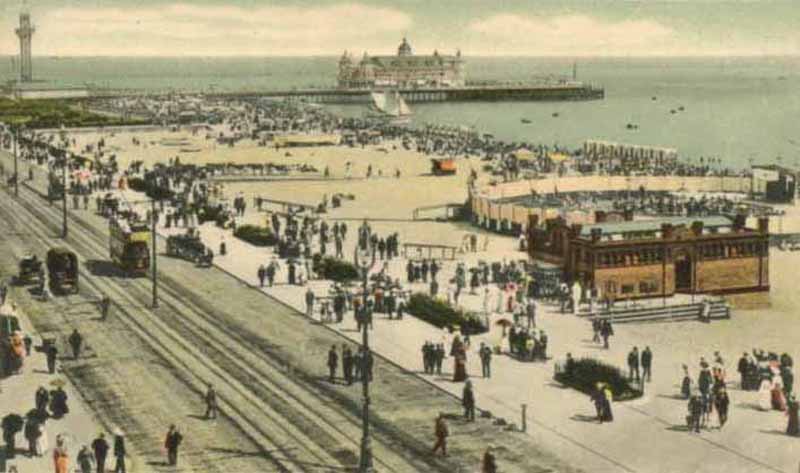
Central Beach at Great Yarmouth c1904. In the background on the left is the Revolving Tower and, on the right, Britannia Pier and pavilion. To the right on the beach is the circular arena which was Chappell’s Singers Ring. The new, electrified tramway can also be seen
Sunday 23rd August 1908
Wet
Morning -
Afternoon -
The last day of the holiday was another wet one so Harry and Lily took shelter in the Winter Gardens by Wellington Pier once again before returning to London by train.
1909
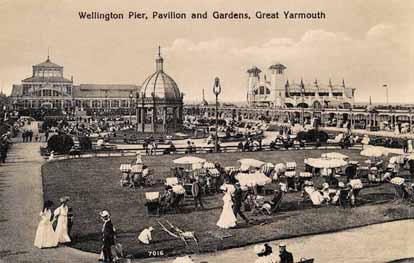
Wellington Pier and gardens c1910
Sunday 8th August 1909
Arrived at Yarmouth 2.10 -
Sat by sea in afternoon.
Listened to band in Wellington Gardens in the evening.
Harry and Lily and Harry’s family returned to Great Yarmouth in August 1909 for the annual holiday. It’s interesting to read that the reliability of the train service was being moaned about back then too! Wellington Gardens were, as the name suggests, part of the Wellington Pier complex which had been bought by the Great Yarmouth Corporation in 1900. The original pier had opened in 1853 but struggled to compete with the more popular Britannia Pier during the latter years of the 19th century. Along with rebuilding the pier, the corporation also built a grand pavilion, added the Winter Gardens (as previously mentioned) and revamped the gardens to include a bandstand.
Mon 9th August 1909
Went for drive to Filby and Ormsby Broads in the morning.
Had a walk alone with Harry about the town & front in the afternoon.
Went to see “Idols” in the evening.
Another trip to the Trinity Broads and an un-

Belton Gardens c1907
Tuesday 10th August 1909
Sat by sea in the morning.
Went for a drive to Belton gardens in the afternoon and went to Chappell’s beach concert in the evening.
Belton, to the south west of Yarmouth, was famed for its market gardens with many of the villagers growing a variety of fruit and vegetables which were sent down to the London markets. Belton Gardens were a popular attraction during the late Victorian and Edwardian era, set beside the Kings Head public house. Visitors to the pleasure gardens could wander amongst the flower beds, take afternoon tea and buy produce grown by the villagers to take home. Regular horse-
Wed 11th August 1909
Sat by the sea in the morning.
Went to Lowestoft by boat on the sea in the afternoon & went to circus in the evening.
Another sea trip for the family during the afternoon. The visit to the “circus” in the evening would probably have been at the Hippodrome.
Thursday 12th August 1909
Went to Cromer (Harry and I). Caught the 9.8 train, very hot day.
Lay by the sea in the morning on golf links in the afternoon and sat on cliffs to see the sunset in the evening.
Returned to Yarmouth 10.15.
A day out on their own for the courting couple. Cromer was another fishing town which had begun to attract wealthy visitors during the early part of the 19th century. The opening of the first rail line in 1877 saw an increase in the numbers arriving and the resort really began to develop during the late Victorian/Edwardian era. As previously mentioned, the travel writer Clement Scott did much to publicise the resort with his articles extolling the beauty of the area that appeared in the national newspapers. I think that Lily and Harry would have taken a train from Yarmouth to North Walsham and then on to Cromer from there. Cromer was also mentioned in many guides to the Norfolk Broads in the late 19th century as a place to visit by train whilst on a boating holiday
Friday 13th August 1909
Sat by sea in the morning.
Went for drive to St Olaves in the afternoon.
Went to see Country Girl at the Aquarium in the evening.
St. Olaves was obviously a favourite spot for the family! “Country Girl” was a musical comedy written by James Tanner, with music and lyrics by Lionel Monckton and Adrian Rose, which had opened in London in 1902.
During the holiday Lily received the following letter from her mother, Ann Child, who mentions her arrangements for holidaying in apartments at Lowestoft and that they would have to “take a car” whilst there. The advice to not “try another boat trip” must mean that Lily was rather sea sick again on their trip by boat to Lowestoft! It’s a shame that we don’t have Lily’s original letter to her mother.
August 13th 1909
3 a Carlton Mews Hornsey
My dear daughter
I am so glad you are having such a good time.
I think you are very fortunate having such fine weather it is very beautiful here. I hope it will continue fine for us when we arrive. We are going to 75 Oxford Road the apartments that was recommended to Hetty by a Muswell Hill lady. The landlady sent us directions how to go when we reach Lowestoft. I should think it is a good way from the sea somewhere near Sparrows nest. We shall have to take a car. Annie has gone to Boultons to get our tickets they are not issuing any from Noel Park. Train starts from Liverpool Street station 6.30 so we shall have to be up early. I was sorry dear you had such a long journey you must have been famished. How was it you did not see Florry. Give my kind regards to Mr and Mrs Caston. You write you have received 1 and 6 Three have been sent.
We had uncle Alf to see us yesterday for the first time he seems rather weak but he will soon get better now he can get out. I shall look forward to seeing you and Harry at Lowestoft one afternoon. Don't try another boat trip. Annie sends her love and she will give you pork and greens when you get home Sunday. Well dear I must conclude with best love to Harry and your dear self
I remain your loving mother
A Child
Is it 4 or 46 you put no 4 on your letter to me
Sat 14th August 1909
Left Yarmouth for Wroxham at 9.20 by boat on the River Bure & Broads.
Lovely trip. Arrived Wroxham at 1.20 & left there again for Yarmouth at 2.20.
Took photos on the boat. Fine & sunny journey home.
Went for walk with Harry by the sea in the evening.
The photograph on the left was the one which was taken on the boat at Wroxham – the bridge can clearly be seen in the background. The boat was almost certainly the “Queen of the Broads” passenger steamer which ran regular day trips from North Quay to Wroxham. A contemporary advert for the Queen of the Broads can be found in the Paper & Ephemera section of the archive and matches the timings for departure and arrival given by Lily. A return trip cost 2/6 although circular tours were also advertised at 3 shillings – one would travel to Wroxham on the Queen of the Broads, take the train to Norwich and then board her sister ship “Pride of the Yare” at Foundry Bridge for the return journey to Yarmouth along the River Yare. On board refreshments were available and a separate “saloon for ladies” was provided.

Onboard the Queen of the Broads at Wroxham
Sunday 15th Aug 1909
Went for a drive to Stokesby in the morning, terribly hot. We were going to Acle but so hot had to return home we were all covered in the flies. Quite a treat to get back to Yarmouth by 12.30 and sat by the sea an hour before dinner.
Sat by the sea with Harry in the afternoon. Lovely afternoon, very sunny but plenty of breeze.
A lovely account which does seem to suggest that the family may possibly have hired a car whilst here. The chain ferry at Stokesby would still have been operational at this time – I wonder whether their intention had been to cross over the River by ferry and head on to Acle that way?
Monday 16th Aug 1909
Sat by the sea in the morning -
Wet afternoon. Went for hours walk about town
Went to see Diana of Dobson’s in the evening
The unpredictable British summer weather strikes again! Another day spent on the beach and around the town with an evening at the theatre watching Diana of Dobson’s for the second time.
Tuesday 17th August 09
Went by boat to Reedham in the morning
Mr and Mrs Caston H(arry )and L(ily )went for a drive to St Olaves in the afternoon.
Went to beach minstrels in the evening.
Another boat trip on one of the passenger steamers which operated from North Quay in Great Yarmouth followed by a return visit to St. Olaves in the afternoon. Although much time was spent in Yarmouth itself, the family did seem to pack quite a lot into their fortnights by visiting other towns and villages.
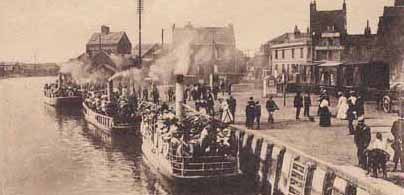
Passenger steamers at South Quay, Great Yarmouth c1910
Wednesday18th August 1909
Sat by the sea in morning.
Went to mother in the afternoon at Lowestoft. Went to tea at mothers
Went to Sparrows nest in the evening to see Pierrots. Very good.
Harry took a photograph of mother Edith Hetty and I.
Arrived back at Yarmouth at 10.15.
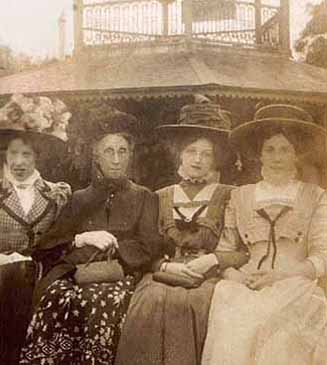
Lily’s mother Ann had arrived for her holiday at Lowestoft which had also seen much development to encourage tourism during the late Victorian and Edwardian era. The Sparrows Nest was originally a private residence, part of the estate owned by Robert Sparrow, but had been bought by the Lowestoft Corporation in 1897 as a venue at which to help celebrate the diamond jubilee of Queen Victoria. Open air concerts were held regularly in the gardens before a theatre pavilion was built in 1913. Pierrots were another extremely popular form of seaside entertainment during the Edwardian era. Based on the French pantomime clowns of the 18th century, the English Pierrot troupes performed songs and comedy routines dressed in an almost standard uniform of baggy white trousers and blousons with ruffled collars, pointy hats and painted, white faces. The photograph on the left was mentioned in Lily’s notes and was actually taken in front of the bandstand in Belle Vue Park at Lowestoft which was beside the Sparrows Nest.
Thursday 19th August 1909
Sat by the sea in the morning. Rained for about an hour so went in the Gem to see the Biograph.
Drive to Somerleyton Park in the afternoon.
Went to Wellington Pier concert in the evening. It was rotten so came out to see the fireworks.
It took a while to decipher the hand written notes which finally revealed that they had visited the Gem Theatre in the morning to escape the rain. The Gem was one of the UK’s first cinemas which had opened at Great Yarmouth in July 1908. Designed by the architect Arthur Hewitt and built for C.B. Cochran, the local authorities stipulated that men and women should sit on opposite sides of the auditorium! Upon its opening, one local newspaper report stated: “A unique feature is that the entertainment is proceeding all day. For a small payment ranging from 1d to 6d, visitors can enter when they please, stay as long as they like and go when they like. On Sundays a series of colour moving tableaux depicting sacred subjects will be on view.” The “Biograph” was an early form of cinema, similar to the cinematograph, which was introduced by the American Mutoscope & Biograph Company in the late 19th century.
Although aimed at those taking boating holidays on the Broads, in 1903 William Dutt wrote; “At Somerleyton he will pass under another railway bridge, near which he may land and stroll up to the model village of Somerleyton, grouped around a pleasant green; and if he be there on a day when the gardens of Somerleyton Hall are open to the public, he cannot do better than see them and the fine Hall, which stands on the old seat of the “Lords of Lothingland.”
Friday 20th August 1909
Sat by the sea in the morning.
Went with Harry to Caister and sat by the sea on the cliffs in the afternoon (rained coming home).
Went to see Marie Studholme in Miss Hook of Holland in the evening.
Born in Eccleshill near Bradford in 1872, Marie Studholme became a darling of musical theatre during the late Victorian era and somewhat of a pin-
Saturday 21st August 1909
Went to Gorleston in the morning.
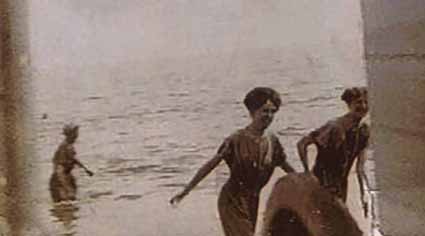
Florrie and I had a bathe and Harry took our photos -
Sat by sea in the afternoon & went to Chappell’s Beach concert in the evening.
???? had a walk by the sea.
The final postcard from the collection was also accompanied by the photograph which Harry had taken of Lily and Florrie as they dashed back towards their bathing machine. Attitudes towards public bathing and the manner in which it was conducted began to change during the Edwardian era.
In the Victorian era there was a conscious effort to avoid the possibility of impropriety and beaches were segregated into areas in which women and men could bathe separately. Men traditionally bathed naked and the few women who were brave, or daring enough, to take to the water wore large, voluminous bathing costumes which virtually covered their entire body and the bathing machines were strictly attended. From the mid 1800s some men also began to wear bathing costumes but many shunned the idea and continued to bathe unclothed. Even in the latter years of the 19th century it was common for men to bathe in the Broads naked but they were instructed to do so before 8am, any ladies in the party being advised not to emerge from their cabins until after this time. Bathing costumes for men became compulsory at many seaside resorts as the Victorian era progressed but mixed bathing was still prohibited. This attitude still prevailed into the early 1900s which probably accounts for Lily’s “naughty boy” comment about Harry having taken their photograph. Swimming costumes became thinner and tighter and attitudes towards public bathing started to be relax, the old bathing machines began to be replaced by changing tents and swimming directly from the beach became the norm during the latter years of the Edwardian era.
Lily Child and Harry Caston 1908 & 1909
Carol Gingell 2012
 Top
Top