
Designed & maintained by Carol Gingell

© C.Gingell 2006-
© Broadland Memories 2006-


Wherries and Mills
More of Charles Hannaford’s photographs -

This is the Lady Edith, better known as the wherry yacht Norada, which was built by Ernest Collins in 1912. Norada remained part of the Collins fleet until being retired in 1950. She was subsequently bought by Frank Andrews who renamed her Lady Edith as a tribute to his wife. This photograph was probably taken during his ownership in the 1950s, and is seen moored here at Clifford Allen’s boatyard in Coltishall.

Another photograph of Lady Edith at Coltishall – you can see the distinctive Anchor Hotel in the background to the left. Lady Edith was bought by Barney Mathews in 1964 who went on to form the Wherry Yacht Charter Trust with Peter Bower. In 1987, her original name of Norada was restored as part of the celebrations for her 75th anniversary.
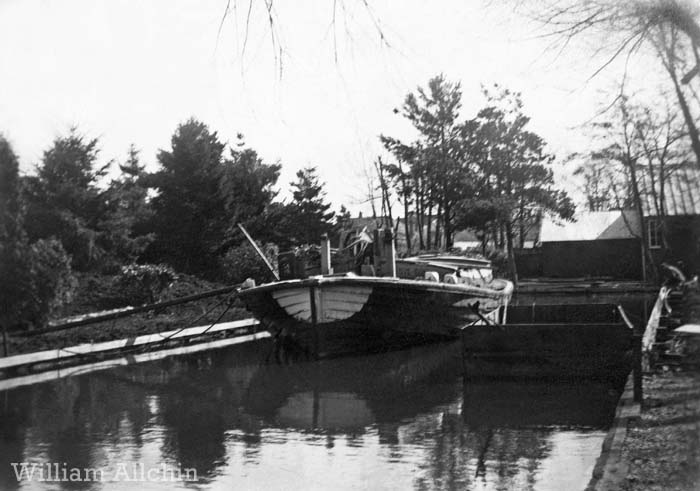
The next two photographs were taken in one of the Broads Tours dykes at Hoveton and show the same trading wherry. My thanks go to the Norfolk Wherry Trust’s archivist Mike Sparkes for identifying this as being “Gleaner”. Gleaner was built at Allen’s of Coltishall in 1894 for Loddon millers and coal merchants Woods, Sad & Moore. She was sold on to George Gedge at Wroxham in 1922, her sail removed and a Thornycroft engine fitted, the mast being retained for use when loading and unloading the wherry.

The second photograph of Gleaner taken at the Broads Tours base. Gleaner eventually passed in to the ownership of George Gedge’s son, Jack. She appears to have led quite an eventful life as an Eastern Daily Press news report from 1931 described her being struck by lightning whilst underway near Acle, and a photograph I’ve seen elsewhere shows her sunk at Womack Staithe in 1955 when she had been carrying a cargo of sugar beet. She seemingly ended her days here at Broads Tours in the 1960s.

Gleaner under sail, probably c1950s.

Another unidentified trading wherry with a very derelict Beaumont’s Mill, south of Ludham Bridge.

Stalham Staithe, unknown date. The buildings you can see were owned by Harry Burton who was a coal and grain merchant. He owned at least three trading wherries including Dispatch, Ceres and Cornucopia – the wherry seen here may well be one of those. The building you can see in the background has, in more recent years, been converted for residential use and are still known as Burton’s Mill. The building to the right is now part of the Museum of The Broads.

This was taken at Horning – another unidentified trader.


An earlier photograph taken at Horning, pre 1928 when the maltings building, seen here on the left, was demolished. Beyond it are boatsheds belonging to H.C. Banham. An unidentified pleasure wherry makes its way downstream on the River Bure.
Another trading wherry – this bears the name board on the right of the owner Harry Burton whose premises at Stalham Staithe are seen further up this page. This would have been either Dispatch, Ceres or Cornucopia. (Thanks to Mike Spakes once again)

– Another pleasure wherry – is this Wroxham/Hoveton?

This dates from the 1950s and I was unsure at first as to whether this was Hathor or Dragon, but I was contacted by John Hopthrow whose father owned the pleasure wherry Dragon during the 1950s to say that this was definitely her with his father seen at the helm. They are towing the family dinghy XIT behind, apparently named after a dwarf in one of his sister’s favourite books.


I think that this may be Albion moored just upstream of Wroxham Bridge c1950s.
Another image taken at Wroxham at the same time as the previous photograph.
Albion underway, probably in the early 1950s.


This was the smock mill which stood near Horning Ferry, pictured in the late 1920s. It was remodelled as a holiday home during the 1930s into the now familiar little white mill which still stands near to the Ferry Inn.
Another photograph showing the original smock mill near Horning Ferry.

The more familiar view of the mill near Horning Ferry after conversion – probably photographed here during the 1950s. There is apparently enough of the original smock mill left under there to warrant a Grade 2 listing on the building, the Norfolk Heritage Explorer lists the original cap, frame and centring wheels as being intact.


Two photographs which show Thurne Dyke Mill in a somewhat unrecognisable state to the present day mill. The mill was built c1820 by the Ludham millwrights England and Co.
These photographs would have been taken pre-

Thurne Dyke Mill pictured in the 1950s, after it had been restored by owner Bob Morse. The mill was subsequently leased out the Norfolk Windmills Trust who cared for it until 2014. Bob Morse passed away in 2007 and the mill was left to Debra Nicholson who took over management of the mill in 2014. Debra also manages the fascinating Wind Energy Museum at Repps with Bastwick which houses Bob Morse’s collection of British, American and Australian windpumps which date from the late 19th to early 20th century and is well worth a visit.


As previously mentioned, most of Charles Hannaford’s photographs were taken to use as subject material for his paintings and this, and the following image, were obviously detail studies of vessels moored alongside Thurne Dyke Mill.
Houseboat alongside Thurne Dyke Mill.


Thurne Dyke Mill must be one of the most photographed and painted mills in Broadland. You can find more information about this and the other mills seen within this collection on the Norfolk Mills website. Further photographs and information can also be found on the website of the Mills Archive organisation.
This is St Benet’s Level Mill – date unknown. Originally built in 1775, the mill was rebuilt by Daniel England in 1898 when an extra ten feet was added to the height of the tower. At some point during the 1880s, a large, American style steel framed windpump was erected inside the old tower, cap removed, and there is an interesting (if rather poor quality) photograph showing this on the Norfolk Mills website. This was apparently damaged during a gale hence being rebuilt by Daniel England. There is also mention elsewhere online of another American style annular sail replacing the cap and sails for a brief period c1900 but no photographs are known to exist.

Thanks to Alison Yardy for identifying this as Clippesby Mill on the River Bure. The mill dates from the early 1800s and apparently shows evidence of having been lived in during its working life, with the remains of a fireplace and plaster remnants on the interior walls. It became a rather basic holiday home in the late 1950s and was struck by lightning in 1978.


Horstead Mill was another much photographed building until its sad demise in the early 1960s. Activity on this site is believed to date back to at least Saxon times and became part of then lands owned by St Benet’s Abbey. It was then given to King’s College by Henry VIII during the dissolution of the monasteries in the 1530s. It is thought that the mill seen here was built in 1789 and King’s College ownership continued until it was sold in 1910 to R.J. Read, the Norwich flour millers. The mill had originally been used to ground corn for flour but Reads began to produce animal feeds here.
Another view of Horstead Mill on the River Bure. The winter of 1962/63 was the coldest on record with temperatures in Norfolk being around 5 degrees lower than the seasonal average. The coldest night of the year was recorded as -