
Designed & maintained by Carol Gingell

© C.Gingell 2006-2026 All photographs, personal stories and written articles on this site are copyright and should not be reproduced anywhere else without the permission of the copyright owner and Broadland Memories.
© Broadland Memories 2006-2026


 1900-1949 History
1900-1949 Memories
<< Pages 31-40
1900-1949 History
1900-1949 Memories
<< Pages 31-40

A collection of photographs of a Norfolk Broads holiday taken from an album which was dated to 1910. This one was rather different for the era, as it was taken aboard a motor launch - The Ibis. The original captions are included below.


“In the Sunshine” - there were no names for the couple who are seen in these photographs, just initials. This lady was H.E.T.
“A blazing day, Old Meadow Dyke” - clearly this was exactly the sort of summer day that William Dutt was describing!


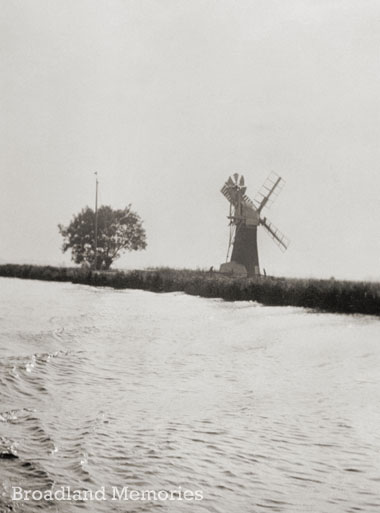
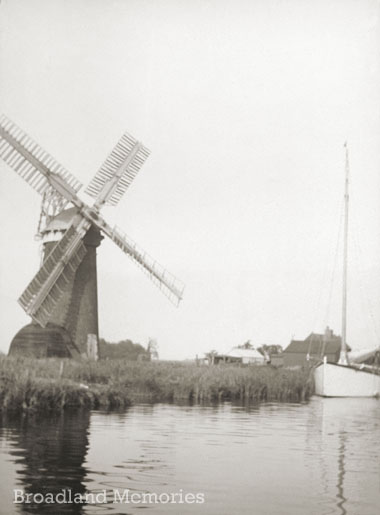
“On the Thurne” - I believe that this was Coldharbour Mill at Ludham. It seems that the end of use for the drainage mills was in sight in 1903 when William Dutt wrote: “Between Womack Dyke and Potter Heigham are two or three fine old windmills, good specimens of the picturesque structures whose work, it is to be feared, will, at no very distant date, be done by ugly brick or corrugated iron housed steam-pumps.”
“Drainage Mill” - also on the River Thurne, this was Horsefen Mill, often referred to as Goodwin’s Mill, which was one of those which stood between Womack and Potter Heigham. Dutt continued: “A spare half-hour may be well spent in examining one of these old mills, especially if the millman is present to explain the working of it. The interior is often an eerie place, badly lighted, and care is needed in climbing the steep, ladder-like flights of steps which connect the floors, but the view from the top of the mill repays one for the climb.”


“A Wherry” - unidentified trading wherry, but it is clearly very well laden.
“A Wherry” - another unidentified trader, photographed in 1910.
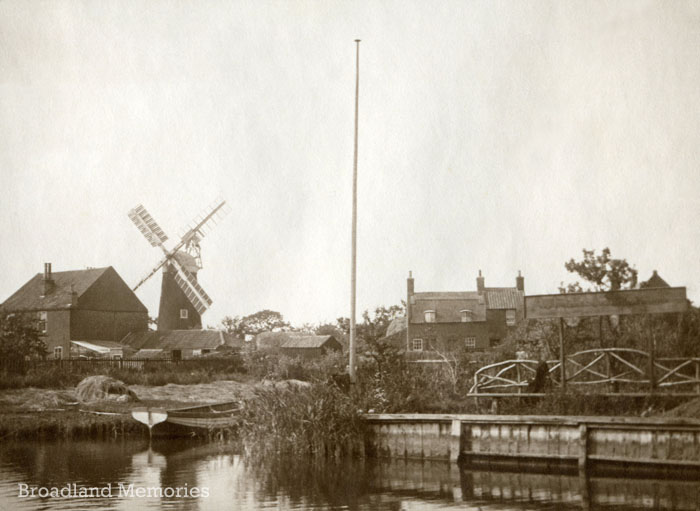


“Wherry on Breydon” - another, unidentified wherry pictured crossing Breydon Water in 1910.
“On Breydon Water” - unidentified wherry yacht, although this is possibly flying a Leo Robinson burgee.


“The Mate on Lookout. H.E.T.” - also taken whilst crossing Breydon Water. Our intrepid duo certainly covered some miles during their holiday, taking in Oulton Broad and Beccles on the Waveney, and up at least as far as Rockland Broad on the River Yare.
“In Lowestoft Harbour” - a great image, showing several of the fishing vessels belonging to W.H. Podd. The stern seen nearest to the quay was that of LT248 “Humphrey”, built in 1908, whilst on the far right of the row is LT1097 “Kestrel”, built in 1907. Wilfred Podd had a sizeable fleet before the outbreak of WW1 but, out of around 30 vessels, only 5 apparently survived the war. Many, including Humphrey, were sunk by enemy submarines as part of the German effort to starve Britain in to submission.


“Beccles” - looking downstream towards Beccles, the low building seen centre,right, was the old swimming baths.
“The Captain mucking about with it” - engine checks 1910 style! That is certainly a hefty set of spanners on the side.
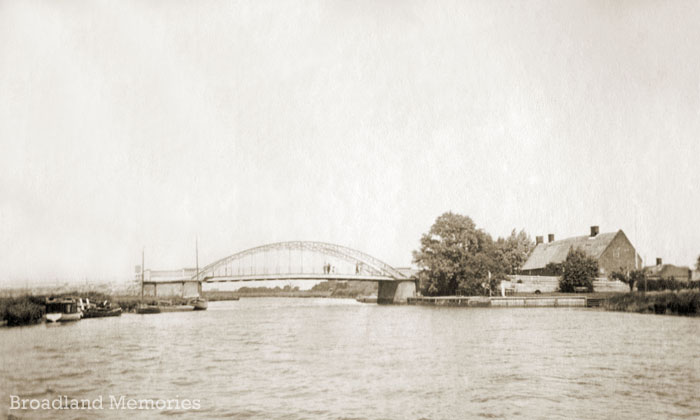


“Potter Heigham Bridge” - taken from the garden of the Bridge Hotel, looking downstream towards the Bridge. You can see the flag flying at George Applegate’s boatyard on the other side.
“Staithe near Stokesby” - this is the old corn tower mill, also known as Trett’s Mill, built in 1826. The tower still stands in the village, although it has long since lost it’s cap and sails.
“On Breydon Water” - the inscription in the front of the photo album shows that the gentleman was G.A.T.
“Lowestoft Harbour” - looking towards the harbour mouth, the fishing drifter seen on the left was LT1089 “Chrysoberyl”, built c1907 for H. Boardly.
“St Olaves” - the bridge at St Olaves, with the Bell Inn seen on the right.
“Rockland Broad” - is the vessel seen on the right dredging, or weed collecting maybe? William Dutt suggested a detour to the broad was worthwhile: “whose wild, primitive aspect has a certain charm lacking in some of the lovelier Broads, suggesting as it does the vanished meres of Fenland. Many a pleasure-seeker, acting on the advice of a boatman whose great anxiety it is to make a speedy voyage from Norwich to Lowestoft or Yarmouth, neglects to enter his dinghy and row up the half mile or so of dyke which leads to Rockland, and so misses seeing what is, to my mind, one of the best of the Norfolk Broads.”
“In Rockland Fleet” - a pair of swans with their young family on the nest.
“”Breakfast” - the final photograph from the 1910 album, and one of the most beautiful. I love the art nouveau design on the table cloth.
“The Ibis” - I don’t have any records for The Ibis, but there were certainly very similar looking vessels listed in Blake’s 1916 brochure. I wonder whether this may have been hired from Potter Heigham, given the destinations seen in the photographs, possibly George Applegate who was certainly advertising the availability of motor launches in 1910. A similar craft, “Marguerite”, was available to hire at Oulton Broad a few years later and was described as being suitable for use as a picnic boat for up to 12 people, or could sleep 2 to 3 overnight. The small cabin would have, presumably, provided two berths whilst the large, canopied front end offered space for a table and seating. It is likely to have included a portable W.C. and a primus stove for cooking purposes.
“Up Old Meadow Dyke” - moored in a quiet spot along the dyke which leads from Heigham Sound, on the Upper Thurne, to Horsey Mere. Old Meadow Dyke was described by William Dutt in 1903 as a place where: “Its water is usually very clear, so that its subaqueous weeds - narrow and broad leaved pond-weeds, matted thyme-weed, and dark bunches of hornwort - which grow luxuriantly, can easily be seen and identified. On both sides of the dyke are wide stretches of marsh, rather more fenny than those bordering the main rivers.”
“Up Old Meadow Dyke” - another photograph of The Ibis taken at the same location. Dutt continued with his description of the dyke: “During July, when the meadow rue, willow-herb, and flowering rush are in full bloom, the dyke banks are very beautiful, and the fragrance of the meadow-sweet on sultry days is almost overpowering. In places the waterside flowers attain such a height as to conceal the haymakers at work on the marshes; they have to be cut down with scythes before the reed-rafts can be loaded with hay. Where such a clearing is made, cruisers on the dyke get a wide view, and see the stalwart marshmen swinging their scythes among the long grass, exposed to the scorching blaze of the summer sun. For on marsh nor dyke is there shelter from the sun-glare, except where the reeds rise high around some narrow inlet, or a reed-thatched cattle shed stands in the midst of the grass and flowers.”
“Breakfast at Potter Heigham” - this was quite possibly taken whilst moored alongside George Applegate’s boat shed near the bridge.
Top
Next
Prev


