
Designed & maintained by Carol Gingell

© C.Gingell 2006-2026 All photographs, personal stories and written articles on this site are copyright and should not be reproduced anywhere else without the permission of the copyright owner and Broadland Memories.
© Broadland Memories 2006-2026


 1900-1949 History
1900-1949 Memories
1900-1949 History
1900-1949 Memories
 Top
Top
The following selection of fifteen photographs are taken from a small album which dates to around 1910. Whilst not in the greatest of condition, they are still of interest. There were no accompanying captions, or indications as to who the holiday party were or where they came from.

I haven’t been able to identify the yacht which was hired by the holiday party but the first image shows one of the group on board using a Primus stove to boil a kettle. Reputedly based on a handheld blowtorch, the Primus stove was developed in Sweden by Franz Lindqvist in 1892 and it’s design changed little over the years. To the right of the stove, housed in a wicker surround, is a stone bottle which was used to fetch and store fresh water for use on board.

Two of the holiday party either preparing, or clearing up after a meal.

The weather was clearly somewhat inclement during their holiday as heavy overcoats were needed!

Taken at the same time as the previous image.




Unidentified river cruiser.
Another unidentified yacht, although it looks like a Leo Robinson’s burgee. On the subject on burgees, the etiquette of the time was described by S.J.Housley in “Comfort in Small Craft” which was published in 1911. He advised: “As the sun goes down, the time of which will be regulated by the senior yacht on the station, haul down the burgee, take it off the halyard, and stow it till eight bells of the morning watch (8 A.M.), when you will hoist again; again taking time from the senior yacht. On the Broads this ceremony is as much honoured in the breach as in the observance.”
Unidentified large house on the Norfolk Broads.
Fishing at a quiet location.
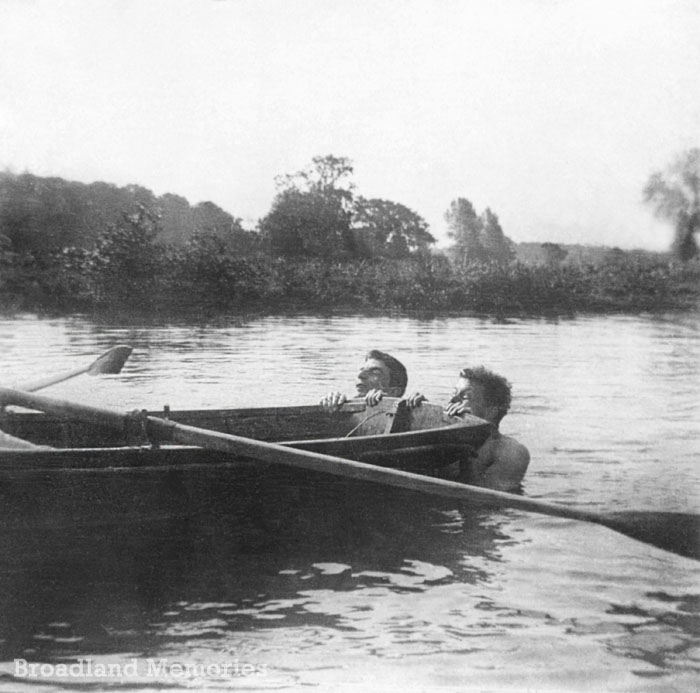
An action shot as one of the crew takes a dip.
Another action shot as a less modest member of the crew goes for a swim without a bathing suit.
It looks like the water might be rather chilly!
A lovely interior shot of the hire yacht with hanging table in the centre.
A trading wherry moored at Womack Staithe with the maltings building seen in the background. In the late 1890s, H.M.Doughty described the way to Womack as being; “the narrowest and most tortuous dyke in Broadland. This so-called Broad is, in truth, just a broadening of the dyke, into a space of some seven acres. It is picturesque, but stagnant, and too set about with houses.”
A pleasure wherry is photographed from a distance – is this Lowestoft or Great Yarmouth harbour? The last photo from the album.
A selection of individual and small sets of photographs, glass negatives and lantern slides which I have gathered over the last few years which date from the early years of the 20th century.





One of a pair of hand coloured glass lantern slides which date from around 1900. This shows the saloon of a what was possibly a large yacht or wherry yacht. How accurate a representation of the original colours is depicted is anybody’s guess!
The second coloured lantern slide from the c1900 set.
The first photograph from a set of six which were taken whilst holidaying on the wherry yacht “White Rose” c1905-1910. White Rose was part of the fleet belonging to George Applegate Jnr. at Potter Heigham and was advertised as sleeping six or seven persons, in three cabins. There was a central saloon with two berths and then fore and aft cabins, each housing a further two berths. The “man” slept in a cot in the forepeak where the cooking stove could also be found.
A lovely photograph of the life ring framing the holiday party’s feet.
Another photograph of the holiday party aboard White Rose.
This appears to have been taken at the same time as the previous image.
White Rose is moored alongside the smock mill which stood just upstream of Horning Ferry. The mill was built by the England’s of Ludham c1880 but, having fallen in to disuse, was converted beyond all recognition in the 1930s into the more familiar landmark of the little, white holiday cottage windmill which still stands on the same spot today.
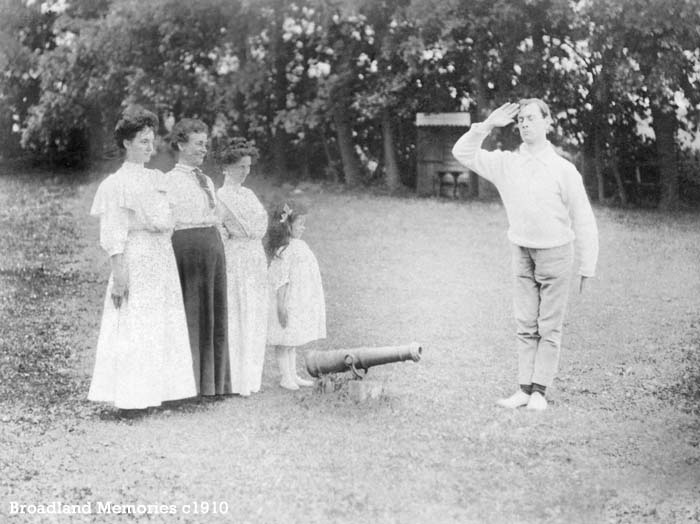
Unknown location where some of the holiday party pose beside an old cannon. The last of the set of six.
This is the first of a set of three photographs which also date from around 1910 - unknown location.
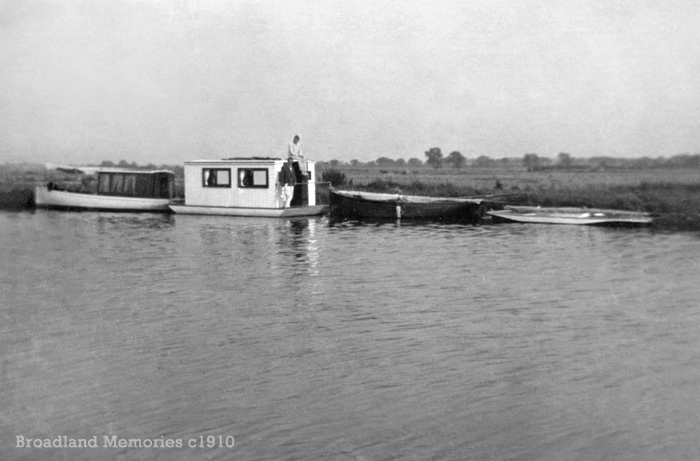
The second photograph from the set shows the little houseboat that the group were standing on in the previous photograph.
The third image is another unidentified location, but obviously a narrow section of river or dyke.
The final image from this selection is a single glass negative which dates from c1905 and was taken at Burgh St Peter on the River Waveney, the distinctive tower of St Mary’s Church is seen in the background. It looks like a field of cabbages behind the young girl.
<< Pages 21-30
Pages 41 on >>
Next
Prev


