
Designed & maintained by Carol Gingell

© C.Gingell 2006-
© Broadland Memories 2006-


 1900-1949 History
1900-1949 Memories
1900-1949 History
1900-1949 Memories
1900-

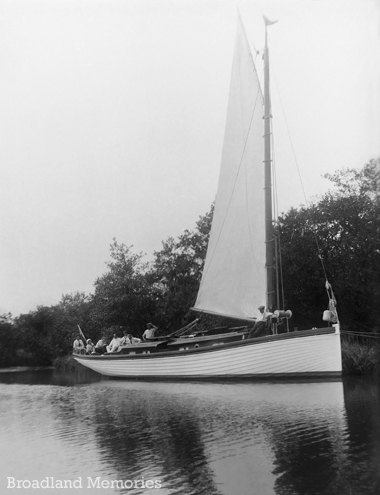
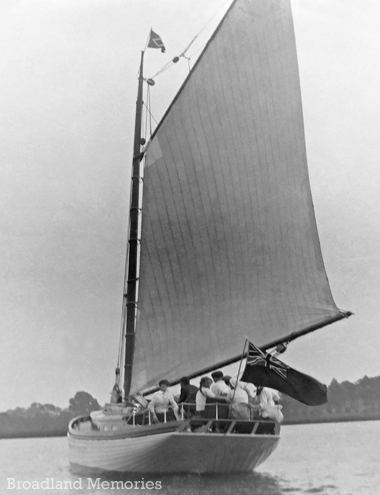
Another interesting set of photographs which have been digitised from the original quarter plate glass negatives. There was no information, or date attached to the negatives but I believe they were taken somewhere between 1916 and 1919. The holiday they document was taken aboard the Wherry Yacht “White Heather” which was hired from Ernest Collins boatyard at Wroxham.
This is the wherry yacht “White Heather”, which was built by Ernest Collins, and it is very distinctive with its clinker hull. The hull was actually salvaged from the wreck of an old beach yawl which used to run trips out to sea from Great Yarmouth. In 1903, whilst out on one such trip, it was in collision with a London steamer causing it to sink, with the sad loss of six lives. The yawl was later recovered, towed to Great Yarmouth where it was bought by Ernest Collins who converted it into a wherry yacht for his fleet at Wroxham.
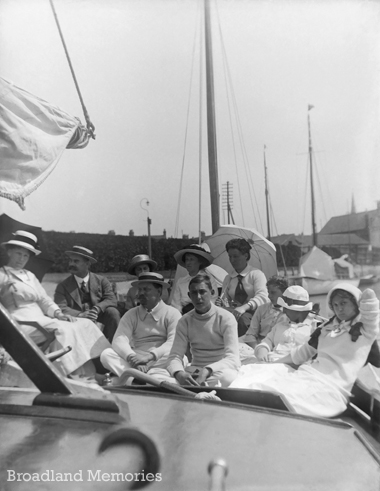
The holiday party aboard White Heather, making the most of the spacious aft deck whilst underway. White Heather could accommodate 8-

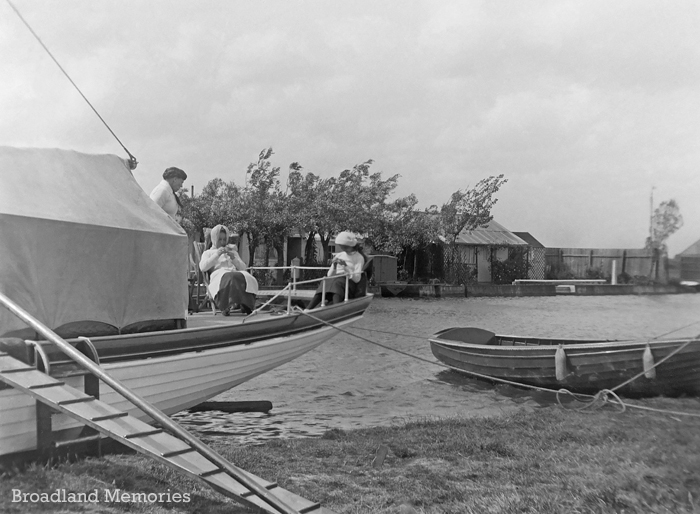





It’s hard to be certain, but I think that this is possibly “Shamrock” or “Reliance” which were built by George Applegate at Potter Heigham.
The three ladies in the holiday party on board White Heather – I’m not sure of the location, but it looks as though it may be Potter Heigham.
Another shot taken whilst underway – White Heather’s skipper can be seen at the helm whilst the attendant is presumably swabbing the decks on the left.
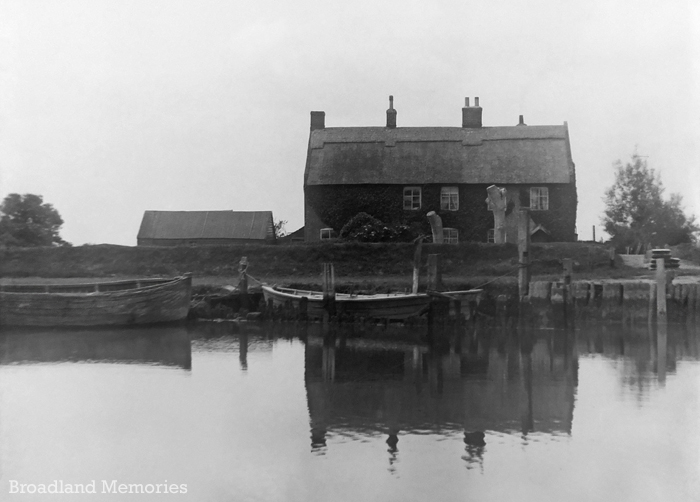
Sadly, the sign on the boatshed isn’t clear enough to read but I presume that the yacht seen must be privately owned.
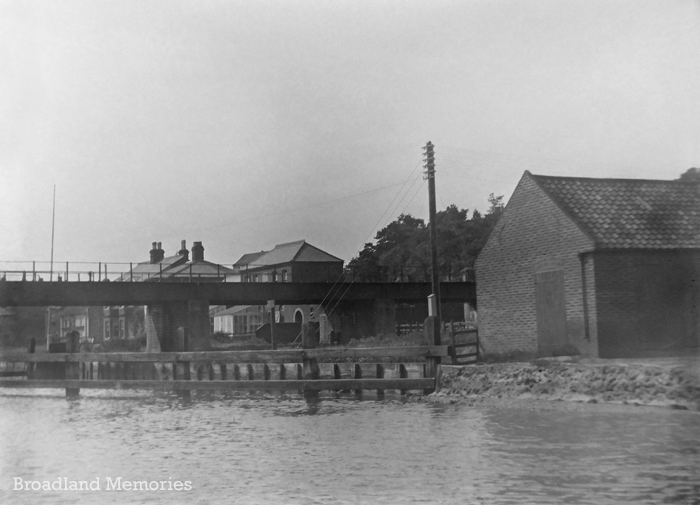
The first of three photographs which were taken whilst passing through Reedham, showing the riverside downstream of the rail bridge. I believe that the edge of the building you can see on the right was “Riverside House” which had been the residence of Isaac Wales who was a timber merchant and cooper. There is a lovely photograph with Norfolk County Council “Picture Norfolk” archives which shows the building in the centre, with two coopers making barrels outside. The business also had a steam saw mill, but this would have presumably gone by the time this photograph was taken. According to Sheila Hutchinson in her book “Reedham Remembered”, after Isaac Wales died, Riverside House was bought by Joseph Dewhurst, and it later became the residence of the Pearson family who ran a boatyard just downstream of the house.
Riverside houses at Reedham, pictured a little further on towards the swing bridge than the previous photograph.
Reedham swing bridge and Riverside, pictured as White Heather heads upstream.
This building looks so familiar, but I haven’t been able to come up with a location yet.
The holiday party pictured on the aft deck of White Heather at Great Yarmouth, the yachting station on the left and the spire of the church of St Nicholas can be seen in the background on the right. With Norman origins, St Nicholas lays claim to being the largest parish church in England. It suffered heavy damage during an air raid in 1942, the resulting fires from German incendiary bombs left little apart from the walls and tower standing. St Nicholas was eventually rebuilt after the war, but its clock apparently remained stuck at 2.35 for many years as a reminder of the fate which befell the church on that night in 1942.
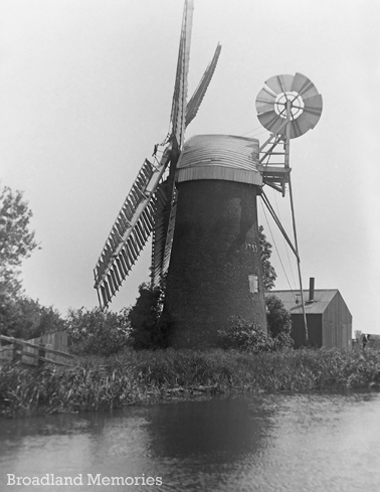
Oby Mill which stands alongside the River Bure within the parishes of Oby and Ashby. It is the oldest remaining mill on the Broads and has a date stone of 1753 incorporated into the tower, as can be seen above. It was built by the then landowners of the Manor House estate, the Wyndeham Cremer family but, from the mid 1830s was tenanted to the Wiseman’s, a family association which lasted through several generations and led to the mill also becoming known as Wiseman’s Mill. Now in need of restoration, it is a rather striking landmark on the river, its protective, shaped tarpaulin cover with the remains of the shaft protruding giving it an almost “Dalek” appearance. It was sold by auction in 2008 but came up for sale again just six years later, bought at this time by the “Missing Kind” charity who now plan to restore the mill with assistance from the Broads Authority and Norwich City College.
The last photo in the set shows Cromer Lighthouse. The holiday party presumably caught the train from Wroxham to Cromer at some point during their holiday, something I’ve done myself whilst holidaying on the Broads. The tower was built by Trinity House in 1833 to replace an earlier lighthouse which, it was expected, would eventually succumb to coastal erosion, the cliff edge being gradually battered away by the encroaching sea. It would have been illuminated by oil lamps at this time, electrification taking place in 1958. Looking at current photographs of the lighthouse, it appears that the attached cottage you can see here must have been replaced at a later date.
Another of the Ernest Collins fleet, pictured at what I think must be either Wroxham or Horning. This was “America” which was built in 1902 and was around 43ft in length. The latter day Norfolk Broads Yachting Company resurrected the name for one of three new yachts built for their fleet in the 1990s, all named after Ernest Collins yachts, and Mike Barnes has done extensive research into the original America over the years and has kindly allowed me to publish his findings here:
“America was built in 1902 and appeared in the very first Blakes Catalogue (1908) where, after the much bigger wherries, she was about the most expensive yacht then available. America was almost certainly built on borrowed money, which for most of the local yards was a common way of funding such a venture, as these boats were far too big and expensive to be afforded otherwise. In fact America appears alongside another very similar boat called ‘IO’, which was commonly held to be a tongue in cheek reference by Collins to his borrowings on the boat; as in ‘I owe’! ‘America’ remained in hire until the Second World War, but didn’t reappear in the Blakes catalogues after the war. Locals remember the boat being finally recommissioned at Wroxham in 1947, having been laid up ashore for the duration of the war. Those that saw her then, noted that she was not properly refitted but simply re-
The 1916 edition of Blake’s Yachting List stated that America had been “altered” for that season. Comparing the boat plans from 1916 and from 1908, it certainly appeared to have had some changes made to the internal layout. A week’s hire during the peak summer months cost £10.